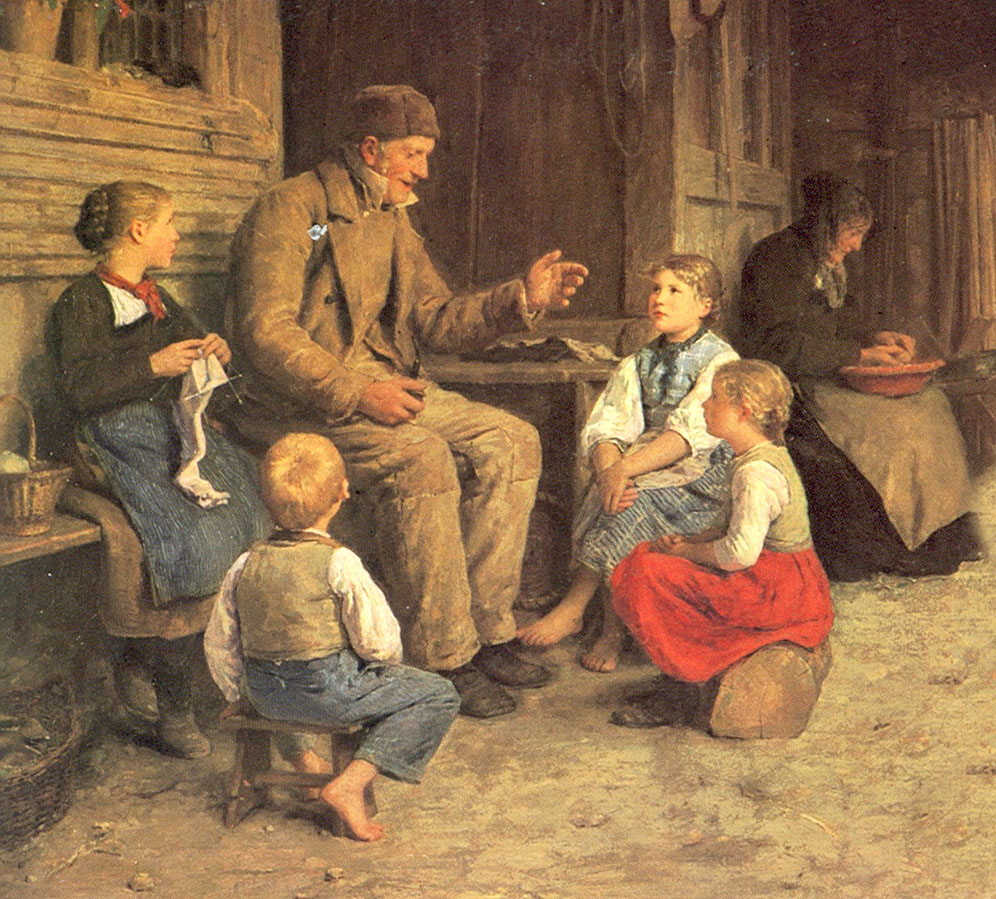
My two-year-old daughter Alice sits at the kitchen bar table eating a snack. I am standing in front of her exhausted from a long day at school and 100% occupied by a jar of toasted almonds. My wife Anne (who is not only my better half but also the more conversational parent by far) has just left the room. The sounds of crunching and smacking are all that fill the room. Alice pauses from eating what appears to be just a mustard-soaked piece of bread from what used to be a turkey sandwich and looks up at me: “Hey Daddy? . . . ” “Yeah, baby, what’s up?” “Hey Daddy, will you talk to me?” “Sure sweetheart! What do you want to talk about?” “I want to talk about Daddy and Alice.” So I start with, “Well, Daddy loves Alice,” then proceed to recount some recent stories that involved her and me.
After this interaction with Alice I thought to myself, “This little conversation has nothing to do with this blog, but I just have to share it.” However, the more I thought about our snack time conversation and the setting in which it took place, the more I began to think that perhaps it has everything to do with this blog.
As Jamie Smith argues in Imagining the Kingdom, “We tell ourselves stories in order to live.” He goes on:
“Narrative is the scaffolding of our experience . . . Stories ‘mean’ on a register that is visceral and bodily, more aesthetic than analytic, ‘made sense of’ more by the imagination than the intellect. Stories are something we learn ‘by heart’ in the sense that they mean on a register that eludes articulation and analysis. A whole world(view) can be compressed in even the most minimal narrative because the story is ‘working’ aesthetically–it means in its cadence and rhythm, in what is said and what is left unsaid, in its tensions and resolutions. I ‘understand’ a story in ways I don’t know.”
Are we telling our children stories? What stories are we telling them? I thought it was so beautiful that Alice wanted me to talk about “Alice and Daddy.” Don’t we all want to hear stories about us and our Daddy? And don’t we all ultimately want to hear stories about us and our Heavenly Daddy? I do think it’s true that the Bible is best read as a love story written to us by our Heavenly Father. I think we all want to hear that Story, whether we know it or not.
But Smith goes on to argue that the most transforming stories are not those that are told discursively in a “once upon a time” manner, but those that are wrapped up in “all the mundane little micropractices” or “liturgies” that we engage in every day.*
So, what story was I telling Alice by the fact that she had to wake me out of my zombie-almond-eating state and request that I talk to her? “Will you talk to me?” is such a sweet, innocent request, but so loaded with meaning, is it not?
If we are too busy or too tired (or too hungry) to talk to our children, to tell them stories, we will still manage to tell them a story, but a much more significant, formative one.
Parents, what stories are we telling our children in those little, seemingly insignificant practices that we engage in (or don’t engage in) every day?
Teachers, what stories are we telling our students in those little, seemingly insignificant practices that are a part of our classroom culture and atmosphere?
The Gospel of Luke tells us “to be faithful in the little things.” Even (especially?) in the little things we are to reflect the Gospel. Are we paying attention to the little things? Are we telling good stories?
~ ~ ~ ~ ~
*Smith develops these arguments beautifully in both Desiring the Kingdom and Imagining the Kingdom, and the practical applications are countless for anyone hoping to cultivate Christian virtue and wisdom in themselves or those around them. I am thankful to my colleagues in classical education for recommending that I engage Smith’s work; I passionately recommend these two titles, especially to teachers who want to do more with their students than just pass on information.
 Pi Alpha
Love this.