Tag Archives: wonder

Recovering Wonder

carbon.atom_.5

In my 8th grade Physical Science class we are currently exploring the history of the atomic model, which naturally leads to some thought-provoking discussions about the ever-evolving epistemology of the subatomic world as well as some mind-bending realizations of and wonder at the level of detail and order that exists at such a small, small scale.  I just love teaching this unit.  For many of these students, this is their first time every thinking about particles on a subatomic scale, where the rules of Newtonian physics fall apart and forces that are 100 undecillion (that’s 1 followed by 38 zeroes) times stronger than gravity exist.  The rabbit trails are always plentiful and I will gladly entertain some of them for days at a time.  It is during this particular unit of study that my class most closely resembles the format and atmosphere of a book discussion group versus a classroom lecture.  And I think this atmosphere is born out of the fact that we are encountering some of the really Big Questions, some of the most fundamental ideas of creation – we are getting a sneak peek into the very mind of God.

I love watching the faces of the students when they learn that all matter in the universe, from a hunk of gold to a zebra, is made up of the same three basic particles: protons, neutrons, and electrons.  The diversity of creation that comes from just those three particles is fascinating.

Today our particular topic centered around the nucleus of the atom, which contains both protons and neutrons.  We learned that, much like a fingerprint is the unique identifier of a human being, the number of protons in the nucleus of an atom is the unique identifier for an element.  Every atom in the universe that contains 79 protons in its nucleus is gold.  Add one more proton to the nucleus and you get something completely different: mercury.  (In fact, many historians believe that, due to many reports of his erratic and eccentric behavior in the years leading up to his death, Isaac Newton actually suffered from (and may have even died from) mercury poisoning.  It was well known that he spent quite a bit of time behind closed doors practicing the “art” of alchemy, trying to turn mercury into gold).  In the midst of this discussion, one student blurted out in disbelief, “Wait, are you telling me that the only thing that determines which of these elements (pointing to the Periodic Table) we have in our hand is the number of protons in the nucleus?!?”  “Yes.  That’s it.”  And his face was filled with pure wonder.

And I was struck.  The palpability of his amazement gave me pause.  Suddenly I realized that over 25 years of holding these ideas in my head and 7 years of teaching them had sort of numbed me a bit to their wondrous beauty.  I knew I had met with a moment that demanded contemplation.  So I literally just paused and thought about the fact that adding one proton to the nucleus of an atom of carbon (a black, brittle solid) would instead give us nitrogen (an inert, colorless gas).  And then it hit me.

“Students, do you find it fascinating that God used the extremely simply concept of quantity to differentiate all the elements of creation?!?  By simply counting out a different number of protons he created a completely different element with completely different properties!!”

The more I thought about it the more excited I became.  Sure, once you get to bigger things like molecules, the arrangement of atoms comes into play (like I discussed here), and sure, chemical bonding takes the complexity to a whole new level.  But the fact that the fundamental building blocks of all creation – the elements – can be differentiated and uniquely identified by a simple count of protons . . . I don’t know, that is beautiful to me.

Eventually I could tell that my students were ready to move on (yes, Mr. F, that’s amazing, now let’s learn something else please), but I have to believe that it makes an impression on them when we, their teachers, are able to model wonder and amazement at God’s creation – especially as math and science teachers.  I’m glad that one of my students caused me to pause and reflect so that I could retrieve that wonder that God’s creation and creativity demands.  Oh that we could borrow the eyes of a child on days that we shrug at a sunset . . .

More on the wonder of a child in a future post – Alice has recently given me much to write about in this regard, not to mention my 6th grade science students (a discussion about the Aurora Borealis today evolved into 30 minutes of playing with magnets – by running a magnet through iron filings you would have thought I was juggling fire.  “Whoa!!  Do it again!”).  Until then, recommended reading on recovering wonder in the classroom: Beauty for Truth’s Sake by Stratford Caldecott.
Buckyball and Other “Useless” Things

buckyball1

Like most teachers I enjoy a good rabbit trail every now and then – okay, perhaps more often than I should.  By 8th grade my students know me well enough and are smart enough to know just which rabbits I will chase, and they throw them out at me with great frequency.  Since I teach my 8th graders three different classes – some days for three periods in a row – rabbit trails are not only common but often a welcomed diversion.

One of the classes I teach to 8th graders is Physical Science.  In a discussion about molecules and their various levels of complexity the other day, we were exploring the intriguing diversity of carbon molecules.  A simple rearrangement of the carbon atoms  in a purely carbon molecule results in a substance with completely different properties.  Arrange the carbon atoms in layers of two-dimensional hexagonal lattices and you have graphite.  Arrange the exact same atoms in a three-dimensional octahedral lattice and you have a diamond.

Of course, the next question was: “What other shapes can carbon atoms make?”  In other words, are there other allotropes of carbon that make for interesting shapes and interesting substances?

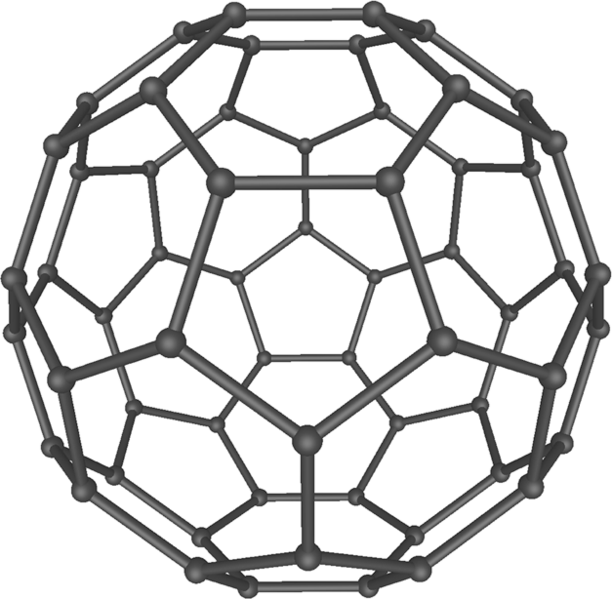
And I couldn’t resist talking about buckminsterfullerene, or “buckyball,” as it is more colloquially referred to in the scientific community.  (Not to be confused with the spherical magnetic toy “buckyball,” which has been discontinued due to safety concerns.  Apparently kids were swallowing these really powerful magnets and strange, unhealthy things were happening in their stomachs as a result.)  The chemical formula for buckyball is C60, and those 60 carbon atoms are arranged in a polyhedral cage-like pattern identical to that represented by the surface of most soccer balls – that is, a 32-face polyhedron (twenty regular hexagons and twelve regular pentagons), each pentagon surrounded by five hexagons, with a carbon atom located at each shared vertex and each shared side representing a C-C bond.  (If this description is unclear, just look at the diagram at the beginning of this post.  A picture is worth a thousand poorly arranged words.)  Buckminsterfullerene was theorized as far back as the 1960s, but not actually discovered (observed) until 1985.

With excitement I described the beautiful shape of C60, showed the students pictures, and practically shouted at them, “Can you believe it looks just like a soccer ball!!  Did we know this when we designed the first soccer ball!?!?”  I even showed them a great ten minute video (students love any excuse to watch a video, don’t they?) all about the uniqueness of C60 (for example, it is the first form of carbon discovered that can be dissolved in water).  I was on a roll.  “I’m really inspiring them,” I thought to myself.

Then, one student raised his hand.  “So, how does buckyball contribute to society?”

<silence>

Now I don’t fault this or any student for asking this question.  It was a perfectly good, perfectly honest question.  But what he really meant was, “How do we use buckyball?”  And in this one innocent question we see how, even in a Christian and classical school, none of us can escape the violence that has been done to education, the lies that have been told since the Industrial Revolution, that voice that lives in our bones and cries out, “IS THIS PRACTICAL?!  WILL THIS HELP ME GET A JOB?!”

The fact is, I told him, although there are many theorized applications, there is no current practical application of buckyball that I am aware of.

The look on his face screamed, “So why do we care?”

So I answered the question he didn’t have to verbalize.  “So what does buckyball contribute to society?  Beauty.  Buckminsterfullerene is beautiful.  We should look at it.  We should contemplate it.  This complex molecule reflects back to us God’s order, His beauty, His fingerprint.  Buckyball contributes the same thing to society that a colorful sunset does.  They both remind us that we are created by and for something much bigger than ourselves.”

In other words, buckyball is worthy of Philippians 4:8.

But we may never do anything with it.  And you probably won’t see it come up on an SAT.

So, was this rabbit trail a waste of time?

“Do Your Math!”

spiral

Many students “don’t like” math because they “can’t do” math.  Many students “can’t do” math because math has only ever been presented to them as something “to do.”  Rarely is math presented as something “to understand,” even less often something “to contemplate,” and hardly ever something “to love.”

Why is that?  We know why.  Math is the lowest hanging fruit (science is a close second) for the “practical” utilitarian agendas of modern education reformers nationwide.

Math tutors everywhere make money hand over foot showing kids how to use shortcuts so that they can “do math.”  “Don’t worry about understanding this concept, just learn the trick!”  Besides, parents aren’t going to pay a tutor to help their child love math; the expected return on their investment is quite simply a solid “A” in the class.

Or a high score on the SAT (don’t get me started).

So we’re left with students (and I was one of them!) who can find the area of a circle, but can tell you nothing about Pi except that it can be approximated as 3.14.

Big deal, you say.  Does a carpenter need to understand the elegant beauty of the design of a screw if he can use screws effectively and efficiently to build a beautiful house?

Maybe not.

But if we decide that math is for doing, not for knowing (much less for loving), then we are withholding beauty and truth (and, in my opinion, a piece of God’s glory) from our students.  In other words, we’re cursing them.  And math class will end up being a complete waste of time for all the students who don’t become engineers or accountants.

But no, you say.  For those non-accountants and non-engineers math still teaches them to think logically!  True.  But if that’s the only use of math for those students, we might as well let them drop math and add more Latin classes.  Oh wait; we can’t do that, can we?  I forgot about those darned SATs!!

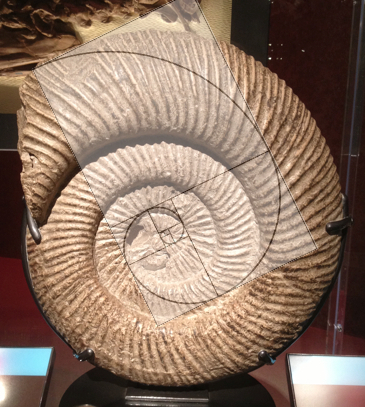
I have some students who can “do math” better than others.  That will always be a reality.  But you know what else I’ve discovered?  When I walk my students through the exercise of creating the spiral of a nautilus shell by starting with the Fibonacci Sequence, the biggest smiles of pure delight (without fail, almost every time) appear on the faces of those students who are not as good at “doing math.”

I find this fascinating, if not sad (for those students who would rather get back to the business of doing math).

The ability to do math is a useful skill that will prepare our students for the marketplace.  The ability to know and love the divine beauty in math will further conform our students into God’s image.

My encouragement to math teachers (myself included!): Make math a conversation (it is a language, after all).  Insist on understanding, on knowing.  Invite contemplation.  Reveal beauty.  Model curiosity and wonder.  Then, and only then, do math.

You may end up covering less, but you will uncover even more.