Tag Archives: what matters

Loving our Way to Truth

truthlove

It seems only fitting to start the new year off with a reminder of what matters and how it is that we might find it.  The following comes from one of Andrew Kern’s posts over on the Circe Institute site.

“For many, the quest to know the truth is a purely rational quest. Thus, for example, Rene Descartes’ resolution to begin by doubting everything – all that he was told, and everything he perceived with his senses. Only by reasoning could he come to know the truth. It’s easy to see why we would think this way. Truth is generally perceived as something we gain through intellectual endeavors. However, what is overlooked in this approach is the health and effectiveness of the truth seeking instrument. The mind interacts with and is largely controlled by the heart, soul, and spirit of the person. Therefore the most perfectly trained mind cannot find truth if the soul of the seeker is disordered. Consequently, and to the chagrin of some intellectuals, truth can only be gained by the soul that is actively loving his neighbor. If she is not doing so, then she is not healthy enough to perceive truth. Instead, she will reduce truth to something that fits within her self-determined parameters. Caritas, Agape, Charity is an infinite act. When a person begins to perform it he comes in contact with an infinite reality deep in his heart. He gains a faculty of perception for things eternal, just as he gains a faculty of perception for things geometrical when he contemplates the definitions and axioms of geometry and he gains a faculty of perception for things artistic when he contemplates and imitates works of art. Only the actively loving person can ever know the truth because the truth is love and is bound to love.”   – Andrew Kern

Truth is a Person

truth

We make the worst mistake in Christian education when we forget that Truth is a Person.

If we teach our students to learn from a purely objective point of view, to hold Truth (“knowledge”) at a distance, to study it in order to master it so that they can use it to get what they want out of life (good grades, good college, good job, good car, good retirement), then why do we act surprised when our students regard Jesus in the same transactional, utilitarian manner?

If our aim is to inform rather than to transform, we will graduate moralists rather than Kingdom bearers, prisoners rather than free men.

Learning in Community

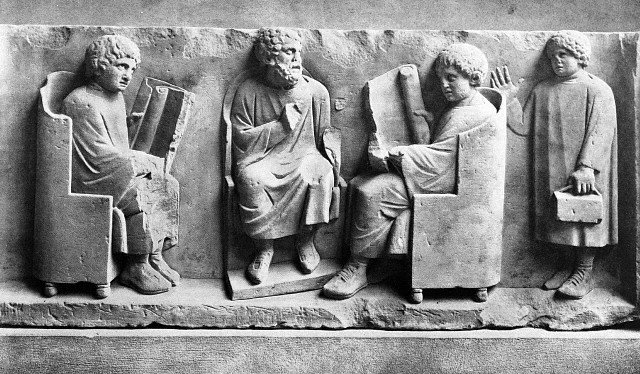
RomanSchool

“It is no surprise that our dominant images of teaching and learning are individualistic and competitive rather than communal; they are derived from images of reality and of knowing that bear these same marks.  If reality consists of atoms in the void or individuals in competition, and if knowing consists of gathering discrete data about objects, then teaching and learning will mean delivering data to students who must compete for those scarce rewards called grades.  But what scholars now say–and what good teachers have always known–is that real learning does not happen until students are brought into relationship with the teacher, with each other, and with the subject.  We cannot learn deeply and well until a community of learning is created in the classroom.”

– Parker Palmer, To Know as We Are Known: Education as a Spiritual Journey

“Knowing is Loving”: Part 1

adamandeve1

In his book To Know as We are Known, Education as a Spiritual Journey, Parker Palmer takes some time in his first chapters to discuss the (d)evolution of the image and purpose of knowledge.  To paraphrase, Palmer posits that in premodern times, knowledge was approached lovingly, reverently, and for the purposes of drawing the knower into a deeper communion with the known, that “hidden wholeness” of creation that Merton speaks about.  Modern images of knowledge, however, suggest that we value knowledge only to the extent that it allows the knower to control, to manipulate, and to lay claim on the known.  In other words, “we value knowledge that allows us to coerce the world into meeting our needs–no matter how much violence we must do.”  Palmer cites the invention of the first atom bomb as an extreme example of this “violence.”

Palmer then connects this denatured image of knowledge to the story of Adam and Eve:

“In the language of religious tradition, Adam and Eve committed the first sin.  In the language of intellectual tradition, they made the first epistemological error.  [. . . ] The sin, the error, is not our hunger for knowledge [. . . , rather] Adam and Eve were driven from the garden because of the kind of knowledge they reached for–a knowledge that distrusted and excluded God.  Their desire to know arose not from love but from curiosity and control, from the desire to possess powers belonging to God alone.  They failed to honor the fact that God knew them first, knew them in their limits as well as their potentials.  In their refusal to know as they were known, they reached for a kind of knowledge that always leads to death.”

I was immediately convicted by this discussion.  As the teacher, “the mediator between the knower and the known, the living link in the epistemological chain,” I repeat this original sin in my classroom whenever I present knowledge as something to “master” or “possess” or “control” rather than something to love for the sake of bringing my students into closer communion with the Lover.

Even in classical Christian education, we talk about “teaching for mastery” and “mastery learning.”  I tell my students every day that they need to “master” this or that.  Sure, I also explicitly lead them in discussions and exercises for the express purpose of cultivating in them a love for math and God’s creation as explored through the sciences, but at the end of the day they are assessed and evaluated (“told their value”) based on what concepts and skills they have mastered.  Is there something out of joint here?

Perhaps instead of telling students that I expect them to master the factoring of polynomials, I should say that I expect them to enter a state of loving communion with polynomials.  This sounds kind of ridiculous, but is it not what Palmer is getting at?  Palmer, Jamie Smith, and a host of others – not to mention our own experience in the classroom, whether as teachers or students – tell us that students are significantly formed by the “hidden curriculum”  in our schools as much if not more as by what we explicitly teach.  If this is indeed the case, then the words we choose to describe the “act of knowing” should really matter.

A Sheep, a Coin, and a Scoundrel

sheepandtree

I used to think that classical Christian education was all about rigor and challenge – a “time tested” method by which to best develop intelligent, logical minds.  The “Christian” part came in I guess either when I gave an especially difficult test and students needed an “I can do all things through Christ” kind of prayer or when I needed to remind students that we, of course, do our best on this test to “bring glory to God.”  (Oh, and I made the occasional reference to “the revelation of God’s character in the order and beauty of math and science,” but I’ve only really begun to “get” the significance of that integration in the last few years.)

So students who had a natural aptitude for math and science loved me, particularly those who enjoyed a challenge.  Their parents loved me too.

Those students who worked really hard but just never quite “got it” became acquainted with a new level of frustration in my classes.  I felt bad for them; but hey, hard work in life doesn’t guarantee success (just ask a farmer).  Although I admired their hard work, my attitude towards them could best be described as pity.  My job was to keep the brightest students challenged.  As for those working feverishly in their shadows, well, “I hope they find a tutor who can bring them along.”

And then there were the students who lacked above average aptitude and either didn’t bother working hard or exhibited very poor work habits (granted those cases were the extreme exception).  Well, I just wrote those students off completely.  That was the “just response,” I thought, for not taking my class seriously.  I guess I kind of took their laziness personally.  “They’ll get the grade they deserve.”

Fortunately, not too long into my teaching career, God convicted me through the help of some very wise parents and the Gospel.  If the Kingdom of Heaven is like a shepherd leaving 99 sheep behind to go search after the one that is lost, or like a woman with 10 coins who turns her house upside down when she loses just one of them . . . well, if I am going to reflect the Gospel in my classroom, then I need to be willing to go after those students who aren’t the best, who aren’t staying up with the rest of the flock.

So I resolved to do just that.  Well, sort of.  As it turns out, I fell short of what I think Christ intended by these parables.  I started to pursue fervently those students in the second group above – that is, those who lacked the above average aptitude but worked their butts off.  I adopted the credo: if you’ll give me all you’ve got, I’ll run along side you all the way.  My new class mantra became, “All I want is your best.  As long as you’re giving me your best, I am pleased.”

In other words, I went to bat for that second group of students because I came to value their hard work in lieu of aptitude.  And boy did I come to love working with those students, mostly because doing so made me feel good about myself.  “Give me a hard working student over a really bright lazy one any day,” I would say, with noble affect.

You see, a lost sheep is still a sheep.  And sheep are fluffy and cute.  And, to a shepherd, each one has tremendous value.  Just like a coin.

Jesus’ parables made sense for the hard working student, but that student who refused to work hard or that student who just couldn’t ever get organized enough to be prepared for class – I still dismissed them both.  They weren’t lost sheep or lost coins, they were just lost.  Sure, I “loved them,” but pitiably so.

Last year God began a new work in me.  Okay, that’s too euphemistic.  He hit me in the face with a baseball bat.  He basically said three things to me:

1) Every child bears my Image.

2) You are only as good a teacher as your “worst” student thinks you are.

3) You need to learn to love grace as much as you love the truth.

So this year I set forth to pursue even the lazy student, even the flippant student, even the student who refused to get organized or refused to work hard or refused to assume responsibility for his or her academics.  But because these descriptions only apply to less than 1% of my students, I found that my “new plan” was actually more difficult – not less – to put into consistent action.  After all, it is much easier to serve the overwhelming majority and ignore those on the fringe.  Especially when your job is to “challenge and prepare academically able minds.”

In fact, a couple weeks ago I caught myself acting dismissively towards a student who not only failed to turn in a major assignment but also refused to come talk to me about it.  I finally had to confront the student a few days later.  When I offered an extension on the assignment, I received no gratitude in return.  “Not even an appreciation of my grace!  Why do I bother extending it?”  Yes, that was my actual thought.  Although I would never say it, I once again dismissed this student as feckless and “unworthy of my valuable time.”

So God took the opportunity this past Sunday morning to clarify for me the true meaning of Jesus’ parables of the lost sheep and lost coin.  Enter the story of Zacchaeus.

Zacchaeus may have been a “wee little man,” but that is where any potentiality for endearment ends.  A chief tax collector in Jericho, Zacchaeus got rich by taking his own cut of the oppressive taxes levied by the Roman government.  Unlike the sheep and coin, which had practical value to both the shepherd and coin owner, Zacchaeus would have been considered a hated scoundrel by everyone who walked with Jesus that day, and perhaps justifiably so.

So we might expect Jesus, who always advocates for those who are given the short end of the stick, to take the side of the crowd when he encounters the immorally wealthy Zacchaeus peering down from the sycamore tree.  I can imagine someone in the crowd saying to Jesus, “Hey, this is our chance!  Tell Zacchaeus how wrong he is!  Put him in his place!!”  Or even, “Ignore that guy, Jesus, he has gotten rich off of our hard-earned money!”

But that of course is not what happens.  Jesus not only invites Zacchaeus down from the tree, but invites himself to be a guest in Zacchaeus’ house.

“So the people began to mutter, ‘He has gone to be the guest of a sinner!’

The crowd could not believe that Jesus didn’t choose someone “more worthy” to spend the evening with.  Jesus’ decision made no sense in their economy.  So Jesus has to remind them of Zacchaeus’ true identity: that he, too, is a son of Abraham.

Do we judge our students by their true identity (the Imago Dei), or by their academic efforts?

And then the story ends with the real kicker.  Jesus says:

“For the Son of Man came to seek and to save what was lost.”

Those words ran through my heart like a bullet.  The “lost” aren’t just cuddly sheep and valuable coins; the lost are scoundrels.

And, when I thought about it, this is very good news for those of us who are scoundrels.  And, if we’re honest, isn’t that all of us?

The very next day I looked at my “problem student” a lot differently.  I pray that my actions towards this student follow suit.  Holy Spirit help me.  I must tirelessly pursue this student, because God has never stopped pursuing me.

So what does it mean to be a “Christian school”?  The longer that I’m on this journey, the more strongly I believe that if we are going to reclaim the integrity of true Christian education, we must aim to reflect the gospel in all aspects of our teaching.  For me that means I have to chase after not only the sheep, but the scoundrels as well.  In other words, I have to chase after the students who are just like me.

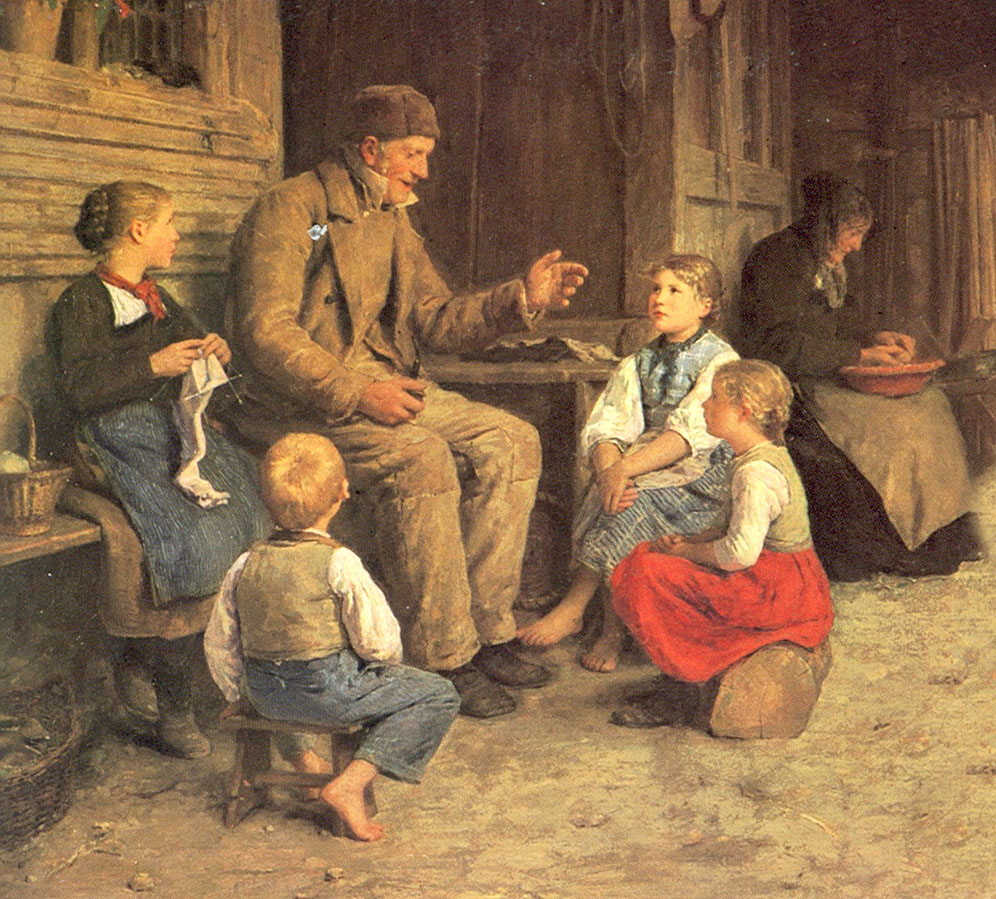
Storytelling

storytelling2

My two-year-old daughter Alice sits at the kitchen bar table eating a snack.  I am standing in front of her exhausted from a long day at school and 100% occupied by a jar of toasted almonds.  My wife Anne (who is not only my better half but also the more conversational parent by far) has just left the room.  The sounds of crunching and smacking are all that fill the room.  Alice pauses from eating what appears to be just a mustard-soaked piece of bread from what used to be a turkey sandwich and looks up at me: “Hey Daddy? . . . ”  “Yeah, baby, what’s up?”  “Hey Daddy, will you talk to me?”  “Sure sweetheart!  What do you want to talk about?”  “I want to talk about Daddy and Alice.”  So I start with, “Well, Daddy loves Alice,” then proceed to recount some recent stories that involved her and me.

After this interaction with Alice I thought to myself, “This little conversation has nothing to do with this blog, but I just have to share it.”  However, the more I thought about our snack time conversation and the setting in which it took place, the more I began to think that perhaps it has everything to do with this blog.

As Jamie Smith argues in Imagining the Kingdom, “We tell ourselves stories in order to live.”  He goes on:

“Narrative is the scaffolding of our experience . . . Stories ‘mean’ on a register that is visceral and bodily, more aesthetic than analytic, ‘made sense of’ more by the imagination than the intellect.  Stories are something we learn ‘by heart’ in the sense that they mean on a register that eludes articulation and analysis.  A whole world(view) can be compressed in even the most minimal narrative because the story is ‘working’ aesthetically–it means in its cadence and rhythm, in what is said and what is left unsaid, in its tensions and resolutions.  I ‘understand’ a story in ways I don’t know.”

Are we telling our children stories?  What stories are we telling them?  I thought it was so beautiful that Alice wanted me to talk about “Alice and Daddy.”  Don’t we all want to hear stories about us and our Daddy?  And don’t we all ultimately want to hear stories about us and our Heavenly Daddy?  I do think it’s true that the Bible is best read as a love story written to us by our Heavenly Father.  I think we all want to hear that Story, whether we know it or not.

But Smith goes on to argue that the most transforming stories are not those that are told discursively in a “once upon a time” manner, but those that are wrapped up in “all the mundane little micropractices” or “liturgies” that we engage in every day.*

So, what story was I telling Alice by the fact that she had to wake me out of my zombie-almond-eating state and request that I talk to her?  “Will you talk to me?” is such a sweet, innocent request, but so loaded with meaning, is it not?

If we are too busy or too tired (or too hungry) to talk to our children, to tell them stories, we will still manage to tell them a story, but a much more significant, formative one.

Parents, what stories are we telling our children in those little, seemingly insignificant practices that we engage in (or don’t engage in) every day?

Teachers, what stories are we telling our students in those little, seemingly insignificant practices that are a part of our classroom culture and atmosphere?

The Gospel of Luke tells us “to be faithful in the little things.”  Even (especially?) in the little things we are to reflect the Gospel.  Are we paying attention to the little things?  Are we telling good stories?

~ ~ ~ ~ ~

*Smith develops these arguments beautifully in both Desiring the Kingdom and Imagining the Kingdom, and the practical applications are countless for anyone hoping to cultivate Christian virtue and wisdom in themselves or those around them.  I am thankful to my colleagues in classical education for recommending that I engage Smith’s work; I passionately recommend these two titles, especially to teachers who want to do more with their students than just pass on information.

What Matters

Everything in a true Christ-centered education (and, thus, a true classical education) comes down to this: are we nurturing the child’s soul?

The worst thing we can do with this question is to consider it globally rather than personally.  Instead of conveniently asking, “Is our school nurturing the souls of its students?” we teachers need to be continually asking ourselves, “Is that science test I just gave or the way I just admonished that student who didn’t do her math homework or the methods I just used to motivate my cross country team or the conversation I just had with students in the lunchroom – are THOSE SPECIFIC ACTIONS OF MINE nurturing the souls of my students?”

There is no small, insignificant, or neutral action when children are placed under our care.  We are either blessing our students’ souls or we’re cursing them, one action at a time.  I wish I could say that I rarely do the latter, that I’ve learned enough about “what matters” and matured enough in my spiritual journey to avoid such a mistake, but that would be a lie.  All it takes is just enough exhaustion or frustration and the next thing I know I have forgotten that my students are just like me: weak, sinful, and in desperate need of grace.

Lord, forgive me.  Students, forgive me.

Only One Thing is Needed

maryfeet

“Now as they went on their way, he entered a certain village, where a woman named Martha welcomed him into her home.  She had a sister named Mary, who sat at the Lord’s feet and listened to what he was saying.  But Martha was distracted by her many tasks; so she came to him and asked, ‘Lord, do you not care that my sister has left me to do all the work by myself? Tell her then to help me.’  But the Lord answered her, ‘Martha, Martha, you are worried and distracted by many things; there is need of only one thing.  Mary has chosen the better part, which will not be taken away from her.’”    Luke 10:38-42 (NRSV)

If the enemy wants to take us out of the Lord’s presence, he will use fear and distraction.  (I say “fear” here but I could just as easily say “worry” – they are basically the same state of being since they are both rooted in our refusal to believe that God is sovereign.)

But let’s get practical, here.  There is a lot to “worry” about – paying our bills on time, making enough money to pay those bills in the first place, getting our kids into the right school, making the right decision about our kids’ education in the first place . . . I could go on, right?  You could too, I imagine.

And what about distractions?  Sure, there are the distractions that we bring upon ourselves (social media, television, hobbies), but what about those distractions we can do nothing about?   Like when I got up early this morning to do some theology reading and my two-year-old woke up an hour early and walked right into the living room as I took my first sip of coffee.  She needed some water, and was a bit cranky from rolling out of bed too early.  So surely, you say, it is the right thing to tend to her needs.  (And, for the record, I did.)

But what about poor Martha?  Surely someone had to prepare dinner for Jesus, and it was Martha’s home, so certainly it was her task – a worthy distraction to prepare a meal for her Lord, right?

But Jesus says there is need of only one thing.  Why does He always do this?  Martha was just trying to be a good host.  I was just trying to read a good book.  Parents just want their children to be safe and happy.

Now I don’t think Jesus was chastising Martha – obviously it was a good thing for her to serve her Lord, just like it is a good thing for me to read and for parents to want the best for their children.

But Jesus says there is need of only one thing.  And in Matthew’s gospel He again tells us to seek that thing first.

I don’t know, maybe Martha should have just chilled out and ordered a pizza.  I find myself asking, “Would Jesus rather have had Martha drop everything and join Mary at His feet, even if it meant that no one got to eat that night?”  That would not be very practical, right?  (never mind the impracticality of Mary dumping a ton of expensive perfume on Jesus feet, which Judas was quick to criticize (John 12))

So if Mary has found “the better part,” then what is keeping us from sitting at the feet of Jesus?

And since this is a blog ultimately about education, I will ask this question another way: what is keeping us from bringing our students to the feet of Jesus?  What is distracting us from first and foremost nurturing their souls?  What are we afraid of?  What are we anxious about?  What are we distracted by?  (Did you get as far as you had planned in the math book this year?)

I think this is worthy of contemplation.