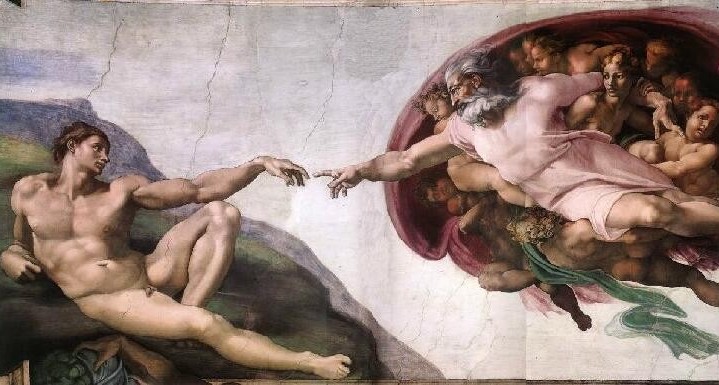
In an earlier post I mentioned that part of the reason for starting this blog was a sudden outpouring of thoughts and reflections on education – and my experience with education, specifically – that I felt the need to write down. Whether or not these thoughts are truly for a larger audience or not remains to be determined.
But what catalyzed this compulsion for reflection? Well I think I can answer that question definitively. What follows below is something I wrote a few weeks ago while my students were taking ERB tests. In fact it was very fortuitous that the students were in standardized testing for two hours, because this was just enough time for me to completely soak the computer screen with a story that I just had to get down in writing that morning. Perhaps this story will give better context for where this blog might be headed.
So, without further preface, here is what I wrote that day.
– – – – – – – – – – – – – – – – – – – – – – – – – – –
“Then God said, ‘Let us make man in our image, in our likeness, and let them rule over the fish of the sea and the birds of the air, over the livestock, over all the earth, and over all the creatures that move along the ground.’ So God created man in his own image, in the image of God he created him; male and female he created them.”
Genesis 2:26-27 (NIV)
This morning I had what can only be described as a conversion experience. One of my coworkers recently turned me on to the Circe Institute, an organization whose expressed purpose is to support and promote classical Christian education. The Circe website is loaded with great resources, my discovery of which came at a time of greater than average hunger for better articulation of the classical Christian mission. Well this morning I was listening to a conference talk by the Circe Institute’s founder, Andrew Kern. In this talk Kern articulated so well what had, to that point in my teaching career, only lived and occasionally welled up inside of me as a passion for what I called “Kingdom teaching.” I knew that this teaching gig was serious business – eternally serious. And I felt like I was doing a decent job. But my articulation of what this “Kingdom teaching” looked like was lacking.
Kern helped me with fleshing out this idea. In his talk, Kern stated very poignantly that our whole purpose as teachers is to strive for the blessedness (i.e., “completion,” “perfection”) of our students – to see them fully realized, that is, to see Christ fully realized in them. Said another way, we are to steward them towards their created purpose: to be the reflection of their Creator.
You have heard it said perhaps many times in church or even educational settings, that if you are having trouble loving someone, think of her as being created in the image of God. I would like to go further though and say that the only way to truly love someone is to love him as an image-bearer. And by extension, the only way to educate someone is to love him as an image-bearer. After all, the word “education” comes from two words in Latin, e ducere, which together mean “to bring out from within.” What are we trying to bring out? I would argue that we are trying to bring out – to draw out – that image of God, that Holy reflection, that Kingdom purpose. And since by teaching we are essentially saying to our students, “Imitate me,” the only way we can draw out that image of God within our students is to be that image ourselves. Lord have mercy. Holy Spirit help us.
That moment that we are reflecting God’s image to our students, and we see that reflection when we look out at them – that is the Narnia moment, the moment of passing through the back of the wardrobe. That is the moment at which we cease to tug at fur coats and begin to grasp at fir trees. That is the moment that we transcend fabrications and encounter authenticity. That is the moment at which the lesson plan falls away and the teacher becomes the curriculum. That is the redemptive moment. That is why we teach.
But redemption does not come without repentance. There is a humility that we must embrace as teachers: this high calling spoken about above is not to be undertaken by our own white-knuckled manipulation and toil. It is only by being in right relationship with God – it is only by being broken, by realizing our utter depravity and God’s infinite goodness, by holding our hands out in total surrender to God – that we are in a position to reflect Christ to our students. We must be washed clean. Daily.
And is that not what our students want as well? The request just looks a little different coming from them. Their moment of repentance in the classroom is the moment at which they confess: “I don’t know.” That is the teachable moment. That is the poverty of spirit that invites redemption. As Andrew Kern says, “The person who is not brought to repentance cannot see the Truth.” Our students want to be washed clean – they desire to embody their created purpose, they yearn to reflect their Almighty God. Will we lead them in this transformative experience? Will we cultivate the trusted relationships and create a safe environment in which they are willing and able to be drawn out – ah, to be educated!?
Do our students know that we desire above all else for them to be washed clean and made perfect in the eyes of God – to be made into the image of their Savior – to fulfill their created purpose – to return to the Garden? Do they trust us enough not to be ashamed?
Let me now return to my experience this morning. Immediately after finishing Kern’s talk, I jumped into the shower, as is my morning routine (it was a school day), but I couldn’t get the talk out of my head. I kept thinking about the significance of this Imago Dei approach to teaching. And then it hit me: I was overwhelmed with grief at how much violence I myself have done to this Truth, how I have not taught as if my students were little image bearers. While washing my hair I was compelled to get down on my knees in the shower and repent. I sobbed. I cried out to God with the same phrase over and over: “Wash me clean, wash me clean.” As I felt the hot water raining down on my head and running across my back my request to God left metaphor. It was a baptism like I had never experienced before. I felt as if God himself was pouring water over me. My only possible response at this point was to worship God, and I did – kneeling right then and there in the shower. I praised Him for His goodness, thanked Him for His redeeming power. I felt clean like never before.
Now I should say at this point that rarely do I get overly emotional about my faith. I will lift my hand in worship at church from time to time, but rarely do I allow my arm to be fully extended. In fact, perhaps my biggest sin is that too often my faith lives in my head and forgets the path to my heart. My point in saying this is that I am not a “fall to my knees” kind of Christian – God have mercy on me. This shower moment was not a normal scene in my faith journey. God truly got to me that morning. He drew me out. He educated me.
So as I continued to do the normal, mundane things of my morning routine, I was still walking on air. I had just gotten dressed, though, when I heard my 23-month-old crying at her bedroom door (which we lock from the outside these days, as she is quite capable of exiting her “big girl bed” and, thus, her room). I walked in to see what the problem was (which usually means just putting her back in bed and telling her that it’s not yet time to get up), and she immediately said, quite pitifully and urgently, “Daddy! Poopoo! Tee-tee!”
Now I have to pause here and insert a disclaimer. I am not about to go into unnecessary detail, but for purposes that I hope will soon become readily apparent, this next part is kind of gross. But I know that for you parents out there, the moment I am about to describe will resonate with you, even if discussion of poopy diapers is typically taboo in any formal social setting, particularly one of higher education. For those of you who are not parents, I apologize in advance.
My daughter Alice had what we call in our house “an epic diaper,” one for the record books. This I knew the moment I walked in the room. It was at this point that I said, “Really, God? I guess this is your way of taking me off the mountaintop and back down to reality.” “The end of my enlightened morning,” I thought.
Now for those of you who have or have had toddlers, you know that diaper changing can sometimes be like the calf-roping contest in a rodeo. Often times Alice will try to outrun or out-climb you in order to avoid a diaper change. And even once you get her on the changing table, often she will arch her back or kick her legs. This does not happen every time, but it certainly happens a lot.
This particular morning was not one of those calf-roping experiences, however. As soon as she announced to me the problem – her filthiness – she walked of her own volition over to the changing table and lifted her arms out for me to pick her up. I placed her on the changing table, and rather than put up a fight, she just laid there peacefully – in relief, even – while I changed her diaper. And it was a messy one. Lots of wipes. Parents, you know what I’m talking about.
But as I was cleaning her up, still a bit aggravated by this “down to Earth” moment coming at the end of an otherwise “heavenly encounter,” I saw out of the corner of my eye my daughter looking up at me, so I turned to look her in the eyes. She continued to fix what I can only describe as an adoring gaze on my face and, when our eyes met, she touched my arm gently, smiled, and said, very softly and peacefully, “Daddy.” I replied, “Hi Alice. Daddy loves you.”
It was in that moment that it all clicked for me. I had come to my daughter in a moment in which she was totally helpless to change her state of being. She was filthy, and she knew it. And she could do nothing about it. But rather than run and hide, she called to me, she told me that she was filthy, and she submitted to the process of being cleaned. And in being cleaned, I think she felt truly loved. I can’t help but contemplate the significance of her naming me in that moment: “Daddy.”
Fathers, I hope you are all changing poopy diapers out there. Don’t let your wife steal all the God-moments! In some gross but very human, very real, very palpable way, I now believe that changing a poopy diaper is one of your first opportunities to reflect the image of Christ to your child in a way that he can truly internalize, long before he will be able to articulate. In a moment of vulnerability and helplessness and filth – filth that always seems to be more disgusting to a father – you have the opportunity to wipe your child clean.
I think God used this experience of changing a big, messy diaper because it is so visceral. I mean, there is no avoiding a physical reaction to an “epic diaper.” Rarely does filth take on a more tangible form. But how often, as adults now, do we underestimate or totally ignore our own dirtiness? As infants and then toddlers we are forthcoming with our filth (do we have a choice?), but sometime very quickly thereafter we learn to hide and then we spend our entire lives trying to “clean ourselves up” or at least pretend to be clean. (Is this not what Adam and Eve did with the fig leaves when they first discovered that they were naked?) By the time we are in middle school, like the students I teach, we have gotten so good at hiding and covering that we don’t even know anymore what it is like to stand in the clearing fully naked – to be fully known. Perhaps we don’t even know who we are anymore. And right about this time adolescence kicks in and we are given even more tangible reasons to run and hide. We eagerly want to be known – to be washed clean – to find our true purpose, but we have no idea how to articulate this let alone where to start.
Folks, I am not just describing teenagers growing up in secular families and attending public schools. I am describing so many of the students in our own Christian schools. Am I not? Sure, our children know how to parrot the Sunday school answers, but they might as well be saying, “I know that I am made in the image of a peanut,” as their likeness to a salty ballpark snack is probably just as ethereal as their Godly birthright. And this is because the world – and so often, too, Christian schools – have hijacked (sometimes without realizing it) the true purpose of education.
And so I was reminded this morning – by God speaking through Mr. Kern and then my daughter – that my role as a teacher, as a father, as an adult in authority over children, is to see Christ fully realized in the children who sit under my tutelage. This necessarily requires that I am in right relationship with God so that I can clearly embody the Truth, this necessarily requires that I am in right relationship with my students so that they trust me enough to adopt a posture of spiritual poverty in my presence. This necessarily requires that I restore the true purpose of education IN MY CLASSROOM. Redemption is always a personal experience, so the recovery of education’s good and proper purpose starts when we close our classroom doors, doesn’t it?
The book of Revelation tells us that our students will one day be priests and rulers in God’s kingdom. Do we believe this? Do we discern within even the most frustrating student the very image of our Redeemer, the very countenance of a king? It is there, that much the entire Testament of our Lord tells us. But are we looking for it? Are we listening for it? Do we even hear it within ourselves?
C.S. Lewis wrote in The Weight of Glory:
“Almost our whole education has been directed to silencing this shy, persistent, inner voice; almost all our modern philosophies have been devised to convince us that the good of man is to be found on this earth.”
Do we know what is at stake here? Do we truly know what it means to teach a “Christ-centered” education?
Will we humbly fall at Christ’s feet and let him wash us clean so they we can see the Truth clearly? Will we invite our students into the same transformative relationship?
Will we, as Kern says, “arouse, listen to, and train this inner voice” that Lewis speaks of? Will we regard our students as the very imago dei? Will we draw them out into the clearing? Will we educate them?

 Pi Alpha