Tag Archives: things I learn from kids

O Come Let Us Adore Him

Processed with VSCOcam with t1 preset

In our home we have a simple yet beautiful nativity set made of hand-painted wooden pegs.  Although our (my?  Anne probably had a better vision all along) initial intent was to create a nice little nativity display for our children to “look at but not touch,” you can probably imagine that these little wooden characters have quickly become one of the new favorite toys of the season, especially for our 2 1/2 year-old Alice.

To be honest, I was initially annoyed by finding shepherds under tables and Joseph in the bathroom, and Eleanor, our 10-month-old, could not keep the spherically-shaped sheep out of her mouth.  And who knew how much angels loved talking to Thomas the Train?

At this point in the story I could talk about how I was eventually convicted by the metaphor for faith that was made painfully obvious to me yesterday:  that we adults, we like to put the story of Jesus on a shelf, to “look at but not touch,” so that we are “reminded of God’s Truth” when we happen to glance over at the display from time to time.  Children, however, are natural integrators of faith.  They are all-in.  The characters of Jesus’ story become regular players in their world, the story of Jesus is wrapped around and through the entire tapestry of their imagination.  Why wouldn’t an angel talk to a train?  “The Kingdom of Heaven belongs to such as these . . . ”

But that’s another post.

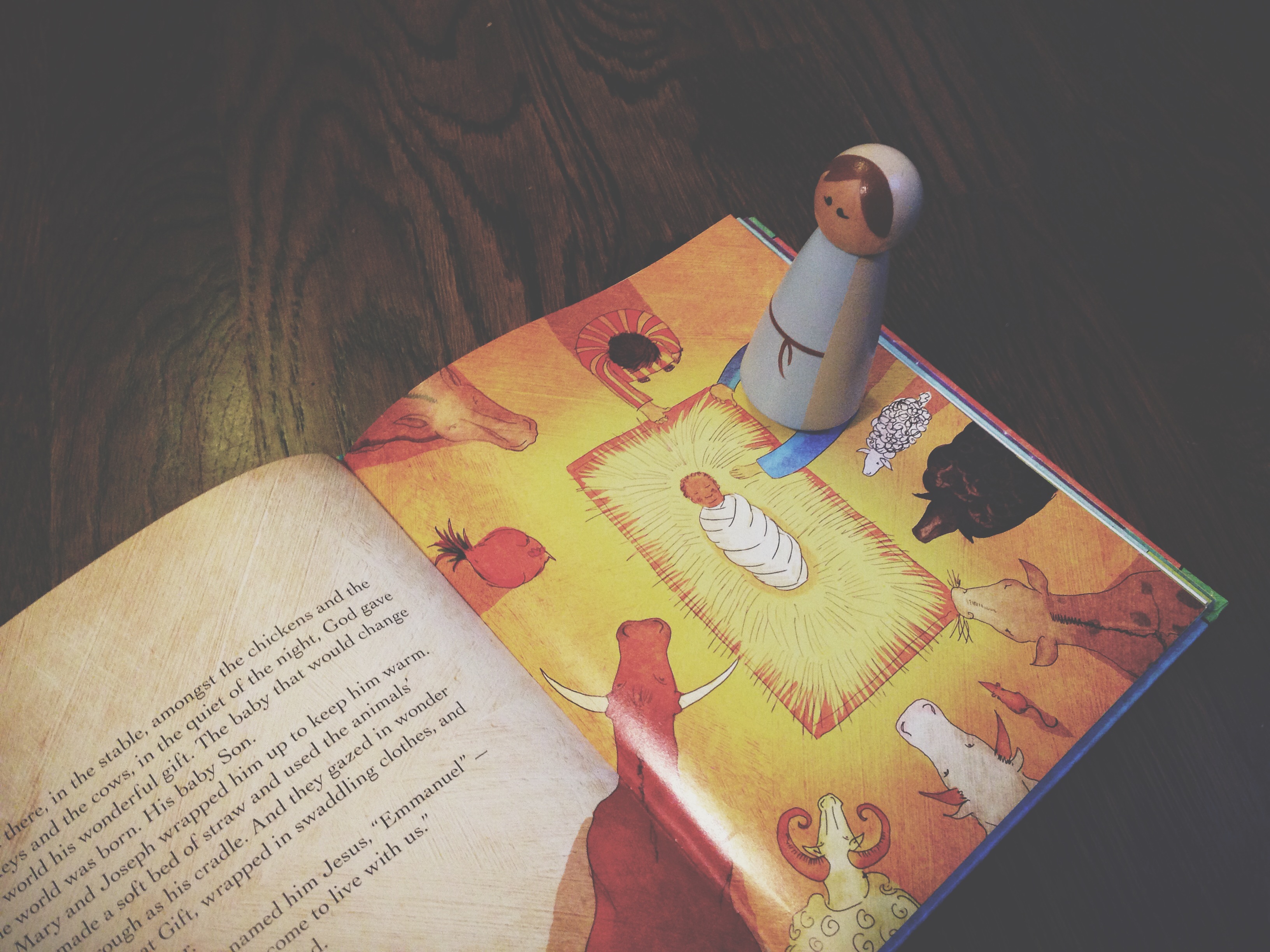
What I want to talk about this morning is what happened two nights ago, when the little wooden Baby Jesus could not be found.  Anne and I were finishing a dinner conversation, and from the next room we could hear Alice walking around saying, “Baby Jesus, where are you?”  A few minutes later we heard, “There you go, Mommy, there’s Baby Jesus.”  And what we found in the adjacent room is pictured at the top of this post.  Alice had searched and searched for the wooden Baby Jesus to no avail, so she found the picture of the manger scene in her Jesus Storybook Bible and placed Mary (Mommy) right on top of the two-dimensional Mary on the page, and positioned her looking directly at her baby.

At the time Anne and I thought this little act was incredibly cute and special and meaningful, but the true meaning didn’t well up within me until last night at church when Anne and I sang along with our congregation, “O Come Let Us Adore Him.”

Adoration.  An often ethereal posture in my faith, I must confess.  Sure, I love Jesus, but how often do I put myself in a posture of adoration?  Do I come to adore Him, or to plead with Him, ask of Him, bargain with Him?

But Alice gets it.  She knew that Mary needed to be adoring the Baby Jesus.  And once she placed Mary in that posture, she left her alone.  The wooden Mary sat on the book adoring the two-dimensional Baby Jesus the rest of the evening (until Eleanor came along).  It’s as if Alice knew that Mary was now at peace.  “There you go, Mommy.  There’s Baby Jesus.”

Good friends, come!  Let us adore Him!

Truth After Silence

candle

[7:00 a.m. Monday morning.  Weekly Bible study with my six 8th-grade boys.  A dozen Dunkin Donuts already consumed.]

Me: “I want to spend our time this morning reflecting on one short text from the first chapter of James:  ‘Count it all joy, my brothers, when you meet trials of various kinds, for you know that the testing of your faith produces steadfastness.  And let steadfastness have its full effect, that you may be perfect and complete, lacking in nothing.‘  Thoughts?

<At least 60 seconds of silence – you know, of the uncomfortable sort>

8th grade boy: “All of us are lacking.”

Thank you, Holy Spirit.

A Sheep, a Coin, and a Scoundrel

sheepandtree

I used to think that classical Christian education was all about rigor and challenge – a “time tested” method by which to best develop intelligent, logical minds.  The “Christian” part came in I guess either when I gave an especially difficult test and students needed an “I can do all things through Christ” kind of prayer or when I needed to remind students that we, of course, do our best on this test to “bring glory to God.”  (Oh, and I made the occasional reference to “the revelation of God’s character in the order and beauty of math and science,” but I’ve only really begun to “get” the significance of that integration in the last few years.)

So students who had a natural aptitude for math and science loved me, particularly those who enjoyed a challenge.  Their parents loved me too.

Those students who worked really hard but just never quite “got it” became acquainted with a new level of frustration in my classes.  I felt bad for them; but hey, hard work in life doesn’t guarantee success (just ask a farmer).  Although I admired their hard work, my attitude towards them could best be described as pity.  My job was to keep the brightest students challenged.  As for those working feverishly in their shadows, well, “I hope they find a tutor who can bring them along.”

And then there were the students who lacked above average aptitude and either didn’t bother working hard or exhibited very poor work habits (granted those cases were the extreme exception).  Well, I just wrote those students off completely.  That was the “just response,” I thought, for not taking my class seriously.  I guess I kind of took their laziness personally.  “They’ll get the grade they deserve.”

Fortunately, not too long into my teaching career, God convicted me through the help of some very wise parents and the Gospel.  If the Kingdom of Heaven is like a shepherd leaving 99 sheep behind to go search after the one that is lost, or like a woman with 10 coins who turns her house upside down when she loses just one of them . . . well, if I am going to reflect the Gospel in my classroom, then I need to be willing to go after those students who aren’t the best, who aren’t staying up with the rest of the flock.

So I resolved to do just that.  Well, sort of.  As it turns out, I fell short of what I think Christ intended by these parables.  I started to pursue fervently those students in the second group above – that is, those who lacked the above average aptitude but worked their butts off.  I adopted the credo: if you’ll give me all you’ve got, I’ll run along side you all the way.  My new class mantra became, “All I want is your best.  As long as you’re giving me your best, I am pleased.”

In other words, I went to bat for that second group of students because I came to value their hard work in lieu of aptitude.  And boy did I come to love working with those students, mostly because doing so made me feel good about myself.  “Give me a hard working student over a really bright lazy one any day,” I would say, with noble affect.

You see, a lost sheep is still a sheep.  And sheep are fluffy and cute.  And, to a shepherd, each one has tremendous value.  Just like a coin.

Jesus’ parables made sense for the hard working student, but that student who refused to work hard or that student who just couldn’t ever get organized enough to be prepared for class – I still dismissed them both.  They weren’t lost sheep or lost coins, they were just lost.  Sure, I “loved them,” but pitiably so.

Last year God began a new work in me.  Okay, that’s too euphemistic.  He hit me in the face with a baseball bat.  He basically said three things to me:

1) Every child bears my Image.

2) You are only as good a teacher as your “worst” student thinks you are.

3) You need to learn to love grace as much as you love the truth.

So this year I set forth to pursue even the lazy student, even the flippant student, even the student who refused to get organized or refused to work hard or refused to assume responsibility for his or her academics.  But because these descriptions only apply to less than 1% of my students, I found that my “new plan” was actually more difficult – not less – to put into consistent action.  After all, it is much easier to serve the overwhelming majority and ignore those on the fringe.  Especially when your job is to “challenge and prepare academically able minds.”

In fact, a couple weeks ago I caught myself acting dismissively towards a student who not only failed to turn in a major assignment but also refused to come talk to me about it.  I finally had to confront the student a few days later.  When I offered an extension on the assignment, I received no gratitude in return.  “Not even an appreciation of my grace!  Why do I bother extending it?”  Yes, that was my actual thought.  Although I would never say it, I once again dismissed this student as feckless and “unworthy of my valuable time.”

So God took the opportunity this past Sunday morning to clarify for me the true meaning of Jesus’ parables of the lost sheep and lost coin.  Enter the story of Zacchaeus.

Zacchaeus may have been a “wee little man,” but that is where any potentiality for endearment ends.  A chief tax collector in Jericho, Zacchaeus got rich by taking his own cut of the oppressive taxes levied by the Roman government.  Unlike the sheep and coin, which had practical value to both the shepherd and coin owner, Zacchaeus would have been considered a hated scoundrel by everyone who walked with Jesus that day, and perhaps justifiably so.

So we might expect Jesus, who always advocates for those who are given the short end of the stick, to take the side of the crowd when he encounters the immorally wealthy Zacchaeus peering down from the sycamore tree.  I can imagine someone in the crowd saying to Jesus, “Hey, this is our chance!  Tell Zacchaeus how wrong he is!  Put him in his place!!”  Or even, “Ignore that guy, Jesus, he has gotten rich off of our hard-earned money!”

But that of course is not what happens.  Jesus not only invites Zacchaeus down from the tree, but invites himself to be a guest in Zacchaeus’ house.

“So the people began to mutter, ‘He has gone to be the guest of a sinner!’

The crowd could not believe that Jesus didn’t choose someone “more worthy” to spend the evening with.  Jesus’ decision made no sense in their economy.  So Jesus has to remind them of Zacchaeus’ true identity: that he, too, is a son of Abraham.

Do we judge our students by their true identity (the Imago Dei), or by their academic efforts?

And then the story ends with the real kicker.  Jesus says:

“For the Son of Man came to seek and to save what was lost.”

Those words ran through my heart like a bullet.  The “lost” aren’t just cuddly sheep and valuable coins; the lost are scoundrels.

And, when I thought about it, this is very good news for those of us who are scoundrels.  And, if we’re honest, isn’t that all of us?

The very next day I looked at my “problem student” a lot differently.  I pray that my actions towards this student follow suit.  Holy Spirit help me.  I must tirelessly pursue this student, because God has never stopped pursuing me.

So what does it mean to be a “Christian school”?  The longer that I’m on this journey, the more strongly I believe that if we are going to reclaim the integrity of true Christian education, we must aim to reflect the gospel in all aspects of our teaching.  For me that means I have to chase after not only the sheep, but the scoundrels as well.  In other words, I have to chase after the students who are just like me.

Recovering Wonder

carbon.atom_.5

In my 8th grade Physical Science class we are currently exploring the history of the atomic model, which naturally leads to some thought-provoking discussions about the ever-evolving epistemology of the subatomic world as well as some mind-bending realizations of and wonder at the level of detail and order that exists at such a small, small scale.  I just love teaching this unit.  For many of these students, this is their first time every thinking about particles on a subatomic scale, where the rules of Newtonian physics fall apart and forces that are 100 undecillion (that’s 1 followed by 38 zeroes) times stronger than gravity exist.  The rabbit trails are always plentiful and I will gladly entertain some of them for days at a time.  It is during this particular unit of study that my class most closely resembles the format and atmosphere of a book discussion group versus a classroom lecture.  And I think this atmosphere is born out of the fact that we are encountering some of the really Big Questions, some of the most fundamental ideas of creation – we are getting a sneak peek into the very mind of God.

I love watching the faces of the students when they learn that all matter in the universe, from a hunk of gold to a zebra, is made up of the same three basic particles: protons, neutrons, and electrons.  The diversity of creation that comes from just those three particles is fascinating.

Today our particular topic centered around the nucleus of the atom, which contains both protons and neutrons.  We learned that, much like a fingerprint is the unique identifier of a human being, the number of protons in the nucleus of an atom is the unique identifier for an element.  Every atom in the universe that contains 79 protons in its nucleus is gold.  Add one more proton to the nucleus and you get something completely different: mercury.  (In fact, many historians believe that, due to many reports of his erratic and eccentric behavior in the years leading up to his death, Isaac Newton actually suffered from (and may have even died from) mercury poisoning.  It was well known that he spent quite a bit of time behind closed doors practicing the “art” of alchemy, trying to turn mercury into gold).  In the midst of this discussion, one student blurted out in disbelief, “Wait, are you telling me that the only thing that determines which of these elements (pointing to the Periodic Table) we have in our hand is the number of protons in the nucleus?!?”  “Yes.  That’s it.”  And his face was filled with pure wonder.

And I was struck.  The palpability of his amazement gave me pause.  Suddenly I realized that over 25 years of holding these ideas in my head and 7 years of teaching them had sort of numbed me a bit to their wondrous beauty.  I knew I had met with a moment that demanded contemplation.  So I literally just paused and thought about the fact that adding one proton to the nucleus of an atom of carbon (a black, brittle solid) would instead give us nitrogen (an inert, colorless gas).  And then it hit me.

“Students, do you find it fascinating that God used the extremely simply concept of quantity to differentiate all the elements of creation?!?  By simply counting out a different number of protons he created a completely different element with completely different properties!!”

The more I thought about it the more excited I became.  Sure, once you get to bigger things like molecules, the arrangement of atoms comes into play (like I discussed here), and sure, chemical bonding takes the complexity to a whole new level.  But the fact that the fundamental building blocks of all creation – the elements – can be differentiated and uniquely identified by a simple count of protons . . . I don’t know, that is beautiful to me.

Eventually I could tell that my students were ready to move on (yes, Mr. F, that’s amazing, now let’s learn something else please), but I have to believe that it makes an impression on them when we, their teachers, are able to model wonder and amazement at God’s creation – especially as math and science teachers.  I’m glad that one of my students caused me to pause and reflect so that I could retrieve that wonder that God’s creation and creativity demands.  Oh that we could borrow the eyes of a child on days that we shrug at a sunset . . .

More on the wonder of a child in a future post – Alice has recently given me much to write about in this regard, not to mention my 6th grade science students (a discussion about the Aurora Borealis today evolved into 30 minutes of playing with magnets – by running a magnet through iron filings you would have thought I was juggling fire.  “Whoa!!  Do it again!”).  Until then, recommended reading on recovering wonder in the classroom: Beauty for Truth’s Sake by Stratford Caldecott.

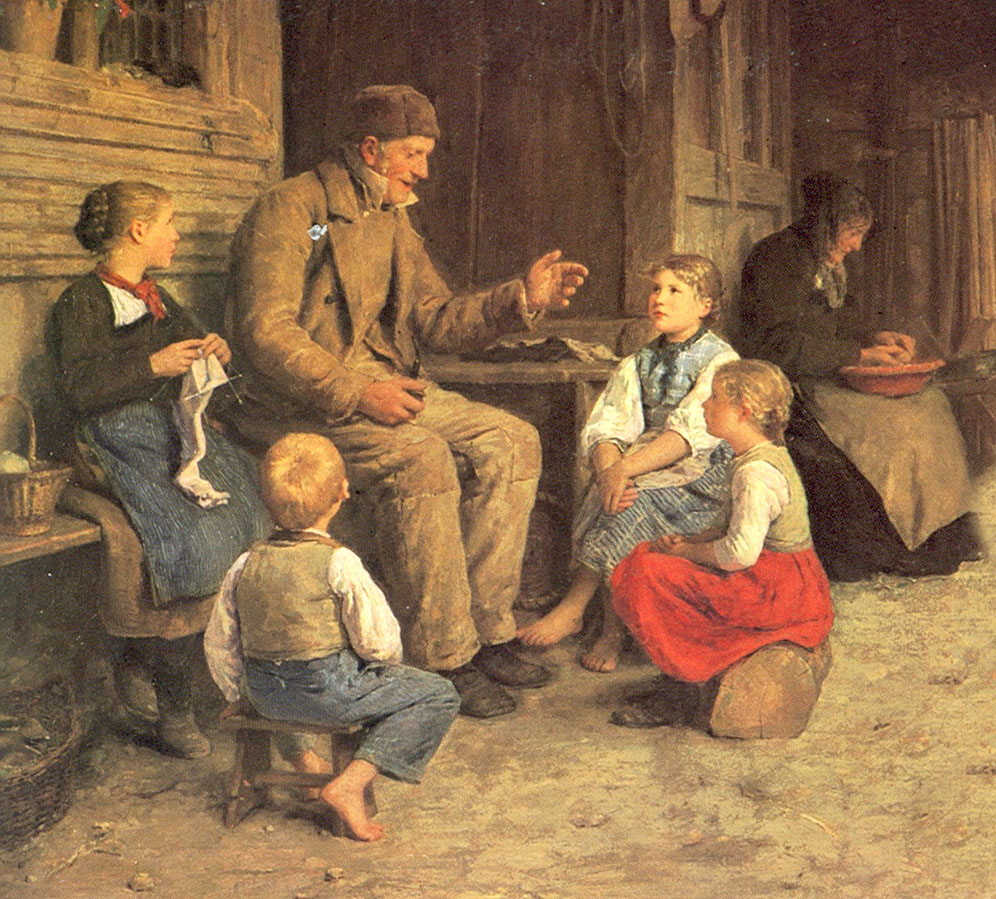
Storytelling

storytelling2

My two-year-old daughter Alice sits at the kitchen bar table eating a snack.  I am standing in front of her exhausted from a long day at school and 100% occupied by a jar of toasted almonds.  My wife Anne (who is not only my better half but also the more conversational parent by far) has just left the room.  The sounds of crunching and smacking are all that fill the room.  Alice pauses from eating what appears to be just a mustard-soaked piece of bread from what used to be a turkey sandwich and looks up at me: “Hey Daddy? . . . ”  “Yeah, baby, what’s up?”  “Hey Daddy, will you talk to me?”  “Sure sweetheart!  What do you want to talk about?”  “I want to talk about Daddy and Alice.”  So I start with, “Well, Daddy loves Alice,” then proceed to recount some recent stories that involved her and me.

After this interaction with Alice I thought to myself, “This little conversation has nothing to do with this blog, but I just have to share it.”  However, the more I thought about our snack time conversation and the setting in which it took place, the more I began to think that perhaps it has everything to do with this blog.

As Jamie Smith argues in Imagining the Kingdom, “We tell ourselves stories in order to live.”  He goes on:

“Narrative is the scaffolding of our experience . . . Stories ‘mean’ on a register that is visceral and bodily, more aesthetic than analytic, ‘made sense of’ more by the imagination than the intellect.  Stories are something we learn ‘by heart’ in the sense that they mean on a register that eludes articulation and analysis.  A whole world(view) can be compressed in even the most minimal narrative because the story is ‘working’ aesthetically–it means in its cadence and rhythm, in what is said and what is left unsaid, in its tensions and resolutions.  I ‘understand’ a story in ways I don’t know.”

Are we telling our children stories?  What stories are we telling them?  I thought it was so beautiful that Alice wanted me to talk about “Alice and Daddy.”  Don’t we all want to hear stories about us and our Daddy?  And don’t we all ultimately want to hear stories about us and our Heavenly Daddy?  I do think it’s true that the Bible is best read as a love story written to us by our Heavenly Father.  I think we all want to hear that Story, whether we know it or not.

But Smith goes on to argue that the most transforming stories are not those that are told discursively in a “once upon a time” manner, but those that are wrapped up in “all the mundane little micropractices” or “liturgies” that we engage in every day.*

So, what story was I telling Alice by the fact that she had to wake me out of my zombie-almond-eating state and request that I talk to her?  “Will you talk to me?” is such a sweet, innocent request, but so loaded with meaning, is it not?

If we are too busy or too tired (or too hungry) to talk to our children, to tell them stories, we will still manage to tell them a story, but a much more significant, formative one.

Parents, what stories are we telling our children in those little, seemingly insignificant practices that we engage in (or don’t engage in) every day?

Teachers, what stories are we telling our students in those little, seemingly insignificant practices that are a part of our classroom culture and atmosphere?

The Gospel of Luke tells us “to be faithful in the little things.”  Even (especially?) in the little things we are to reflect the Gospel.  Are we paying attention to the little things?  Are we telling good stories?

~ ~ ~ ~ ~

*Smith develops these arguments beautifully in both Desiring the Kingdom and Imagining the Kingdom, and the practical applications are countless for anyone hoping to cultivate Christian virtue and wisdom in themselves or those around them.  I am thankful to my colleagues in classical education for recommending that I engage Smith’s work; I passionately recommend these two titles, especially to teachers who want to do more with their students than just pass on information.

On Truth and Freedom (or, Math as a Liberal Art)

OLYMPUS DIGITAL CAMERA

“Mr. Faulkner, I really struggled with this problem.  I knew I was somewhat on the right track but I just could not figure out how to get to the answer.  So I started to get frustrated, but I kept working.  Then finally I figured it out and I was so excited that I shouted, ‘Yes, I’ve got it!’ so loudly that my mom heard me from the next room.”

“And how did you feel when you finally found the way to the answer?”

“I felt . . . I felt free.”

__  __  __  __  __

“For now we see in a mirror dimly, but then face to face; now I know in part, but then I will know fully just as I also have been fully known.”  1 Corinthians 13:12

“And you will know the truth, and the truth will set you free.”  John 8:32

Why I Should Ask Kids About Jesus More Often

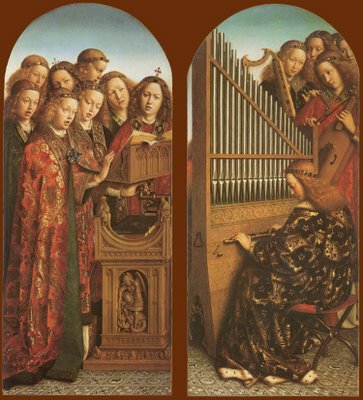
van eyck angels singing

I had the pleasure of interviewing a remarkable 6th grade boy last week for admission into our middle school.  He and a girl from his same class were both interviewing the same day.  As it turns out they are good friends, having found common ground in the fact that they both enjoy learning (which characteristic apparently and unfortunately exiled them to the margins of the social order at their particular school).

In addition to being good friends, this young boy and girl are also coauthoring a fictional novel, described by the girl (also remarkable) as an “apocalyptic fantasy.”  When asked what his major contribution to the writing process was, the boy responded, “I tend to enjoy metaphors and sensory details.”  He then went on to describe the female protagonist in their novel as “from humble roots but fierce, with icy blue eyes.”

Actually I spent most of both interviews asking for more details about their novel.  I also made them agree to use me as an editor before they seek publication.

But I also always ask interviewees to describe their relationship with Jesus.  The reader must recognize that the expectations for the response to this question are not unrealistic; we’re talking 11-year-olds most of the time here.  God knows that I still struggle with a vivid articulation of my own faith at 36.  However – as I have learned in my teaching experience over and over again – Jesus was not kidding when he said in Matthew 18:3, “Unless you change and become like little children, you will never enter the kingdom of heaven.”  In this interview I was going to be reminded of this truth again.

Since he had been so eloquent with his words thus far in the interview, I decided to ask my faith question to this young boy in a more elevated manner.  So, after tearing myself away from further questions about the novel, I asked, “How would you characterize your relationship with Jesus?”

Without hesitation and with the most humble sincerity, he replied, “Well, I sing.  I sing to him.  That’s what I do for him.  And I know he listens.  And often he replies.”

At this point it took my full constitution for me to keep it together and finish the interview without freaking this poor child out by crying.

In that moment of honesty Jesus spoke to me through that 6th grade boy.  He said, “How does this boy characterize his relationship with me?  By worship.  Worship characterizes his relationship with his Savior.”

This 6th grade boy gets it.  He gets it so much more than I do most of the time.  Now he may not get it “intellectually,” but that is the point, isn’t it?  This posture of worship – this desire to worship as an expression of his love for the object of his affection – is just what he does, is just who he is, so much so that he says, “I sing,” as simply and matter-of-factly as I would say, “I eat,” if someone asked me what I do when I get hungry.

If there is a good example of virtue, well there it is.

“I will sing of steadfast love and justice; to you, O Lord, I will make music.” Psalm 101:1 (ESV)

Imago Dei and the Holy Act of Diaper Changing (or, Where This All Might Have Started)

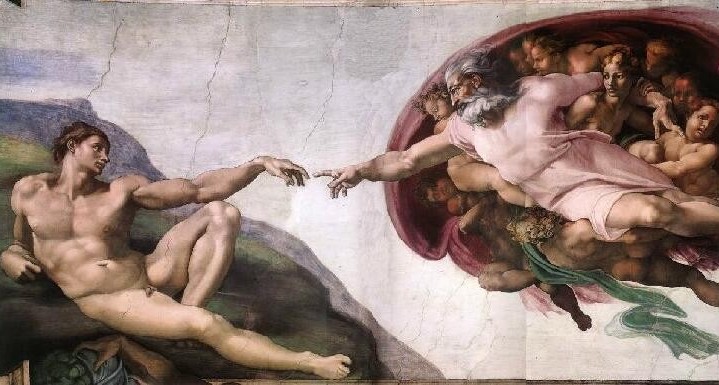
imagodeiimage

In an earlier post I mentioned that part of the reason for starting this blog was a sudden outpouring of thoughts and reflections on education – and my experience with education, specifically – that I felt the need to write down.  Whether or not these thoughts are truly for a larger audience or not remains to be determined.

But what catalyzed this compulsion for reflection?  Well I think I can answer that question definitively.  What follows below is something I wrote a few weeks ago while my students were taking ERB tests.  In fact it was very fortuitous that the students were in standardized testing for two hours, because this was just enough time for me to completely soak the computer screen with a story that I just had to get down in writing that morning.  Perhaps this story will give better context for where this blog might be headed.

So, without further preface, here is what I wrote that day.

– – – – – – – – – – – – – – – – – – – – – – – – – – –

“Then God said, ‘Let us make man in our image, in our likeness, and let them rule over the fish of the sea and the birds of the air, over the livestock, over all the earth, and over all the creatures that move along the ground.’  So God created man in his own image, in the image of God he created him; male and female he created them.” 

Genesis 2:26-27 (NIV)

This morning I had what can only be described as a conversion experience.  One of my coworkers recently turned me on to the Circe Institute, an organization whose expressed purpose is to support and promote classical Christian education.  The Circe website is loaded with great resources, my discovery of which came at a time of greater than average hunger for better articulation of the classical Christian mission.  Well this morning I was listening to a conference talk by the Circe Institute’s founder, Andrew Kern.  In this talk Kern articulated so well what had, to that point in my teaching career, only lived and occasionally welled up inside of me as a passion for what I called “Kingdom teaching.”  I knew that this teaching gig was serious business – eternally serious.  And I felt like I was doing a decent job.  But my articulation of what this “Kingdom teaching” looked like was lacking.

Kern helped me with fleshing out this idea.  In his talk, Kern stated very poignantly that our whole purpose as teachers is to strive for the blessedness (i.e., “completion,” “perfection”) of our students – to see them fully realized, that is, to see Christ fully realized in them.  Said another way, we are to steward them towards their created purpose: to be the reflection of their Creator.

You have heard it said perhaps many times in church or even educational settings, that if you are having trouble loving someone, think of her as being created in the image of God.  I would like to go further though and say that the only way to truly love someone is to love him as an image-bearer.  And by extension, the only way to educate someone is to love him as an image-bearer.  After all, the word “education” comes from two words in Latin, e ducere, which together mean “to bring out from within.”  What are we trying to bring out?  I would argue that we are trying to bring out – to draw out – that image of God, that Holy reflection, that Kingdom purpose.  And since by teaching we are essentially saying to our students, “Imitate me,” the only way we can draw out that image of God within our students is to be that image ourselves.  Lord have mercy.  Holy Spirit help us.

That moment that we are reflecting God’s image to our students, and we see that reflection when we look out at them – that is the Narnia moment, the moment of passing through the back of the wardrobe.  That is the moment at which we cease to tug at fur coats and begin to grasp at fir trees.  That is the moment that we transcend fabrications and encounter authenticity.  That is the moment at which the lesson plan falls away and the teacher becomes the curriculum.  That is the redemptive moment.  That is why we teach.

But redemption does not come without repentance.  There is a humility that we must embrace as teachers: this high calling spoken about above is not to be undertaken by our own white-knuckled manipulation and toil.  It is only by being in right relationship with God – it is only by being broken, by realizing our utter depravity and God’s infinite goodness, by holding our hands out in total surrender to God – that we are in a position to reflect Christ to our students.  We must be washed clean.  Daily.

And is that not what our students want as well?  The request just looks a little different coming from them.  Their moment of repentance in the classroom is the moment at which they confess: “I don’t know.”  That is the teachable moment.  That is the poverty of spirit that invites redemption.  As Andrew Kern says, “The person who is not brought to repentance cannot see the Truth.”  Our students want to be washed clean – they desire to embody their created purpose, they yearn to reflect their Almighty God.  Will we lead them in this transformative experience?  Will we cultivate the trusted relationships and create a safe environment in which they are willing and able to be drawn out – ah, to be educated!?

Do our students know that we desire above all else for them to be washed clean and made perfect in the eyes of God – to be made into the image of their Savior – to fulfill their created purpose – to return to the Garden?  Do they trust us enough not to be ashamed?

Let me now return to my experience this morning.  Immediately after finishing Kern’s talk, I jumped into the shower, as is my morning routine (it was a school day), but I couldn’t get the talk out of my head.  I kept thinking about the significance of this Imago Dei approach to teaching.  And then it hit me: I was overwhelmed with grief at how much violence I myself have done to this Truth, how I have not taught as if my students were little image bearers.  While washing my hair I was compelled to get down on my knees in the shower and repent.  I sobbed.  I cried out to God with the same phrase over and over: “Wash me clean, wash me clean.”  As I felt the hot water raining down on my head and running across my back my request to God left metaphor.  It was a baptism like I had never experienced before.  I felt as if God himself was pouring water over me.  My only possible response at this point was to worship God, and I did – kneeling right then and there in the shower.  I praised Him for His goodness, thanked Him for His redeeming power.  I felt clean like never before.

Now I should say at this point that rarely do I get overly emotional about my faith.  I will lift my hand in worship at church from time to time, but rarely do I allow my arm to be fully extended.  In fact, perhaps my biggest sin is that too often my faith lives in my head and forgets the path to my heart.  My point in saying this is that I am not a “fall to my knees” kind of Christian – God have mercy on me.  This shower moment was not a normal scene in my faith journey.  God truly got to me that morning.  He drew me out.  He educated me.

So as I continued to do the normal, mundane things of my morning routine, I was still walking on air.  I had just gotten dressed, though, when I heard my 23-month-old crying at her bedroom door (which we lock from the outside these days, as she is quite capable of exiting her “big girl bed” and, thus, her room).  I walked in to see what the problem was (which usually means just putting her back in bed and telling her that it’s not yet time to get up), and she immediately said, quite pitifully and urgently, “Daddy!  Poopoo!  Tee-tee!”

Now I have to pause here and insert a disclaimer.  I am not about to go into unnecessary detail, but for purposes that I hope will soon become readily apparent, this next part is kind of gross.  But I know that for you parents out there, the moment I am about to describe will resonate with you, even if discussion of poopy diapers is typically taboo in any formal social setting, particularly one of higher education.  For those of you who are not parents, I apologize in advance.

My daughter Alice had what we call in our house “an epic diaper,” one for the record books.  This I knew the moment I walked in the room.  It was at this point that I said, “Really, God?  I guess this is your way of taking me off the mountaintop and back down to reality.”  “The end of my enlightened morning,” I thought.

Now for those of you who have or have had toddlers, you know that diaper changing can sometimes be like the calf-roping contest in a rodeo.  Often times Alice will try to outrun or out-climb you in order to avoid a diaper change.  And even once you get her on the changing table, often she will arch her back or kick her legs.  This does not happen every time, but it certainly happens a lot.

This particular morning was not one of those calf-roping experiences, however.  As soon as she announced to me the problem – her filthiness – she walked of her own volition over to the changing table and lifted her arms out for me to pick her up.  I placed her on the changing table, and rather than put up a fight, she just laid there peacefully – in relief, even – while I changed her diaper.  And it was a messy one.  Lots of wipes.  Parents, you know what I’m talking about.

But as I was cleaning her up, still a bit aggravated by this “down to Earth” moment coming at the end of an otherwise “heavenly encounter,” I saw out of the corner of my eye my daughter looking up at me, so I turned to look her in the eyes.  She continued to fix what I can only describe as an adoring gaze on my face and, when our eyes met, she touched my arm gently, smiled, and said, very softly and peacefully, “Daddy.”  I replied, “Hi Alice.  Daddy loves you.”

It was in that moment that it all clicked for me.  I had come to my daughter in a moment in which she was totally helpless to change her state of being.  She was filthy, and she knew it.  And she could do nothing about it.  But rather than run and hide, she called to me, she told me that she was filthy, and she submitted to the process of being cleaned.  And in being cleaned, I think she felt truly loved.  I can’t help but contemplate the significance of her naming me in that moment: “Daddy.”

Fathers, I hope you are all changing poopy diapers out there.  Don’t let your wife steal all the God-moments!  In some gross but very human, very real, very palpable way, I now believe that changing a poopy diaper is one of your first opportunities to reflect the image of Christ to your child in a way that he can truly internalize, long before he will be able to articulate.  In a moment of vulnerability and helplessness and filth – filth that always seems to be more disgusting to a father – you have the opportunity to wipe your child clean.

I think God used this experience of changing a big, messy diaper because it is so visceral.  I mean, there is no avoiding a physical reaction to an “epic diaper.”  Rarely does filth take on a more tangible form.  But how often, as adults now, do we underestimate or totally ignore our own dirtiness?  As infants and then toddlers we are forthcoming with our filth (do we have a choice?), but sometime very quickly thereafter we learn to hide and then we spend our entire lives trying to “clean ourselves up” or at least pretend to be clean.  (Is this not what Adam and Eve did with the fig leaves when they first discovered that they were naked?)  By the time we are in middle school, like the students I teach, we have gotten so good at hiding and covering that we don’t even know anymore what it is like to stand in the clearing fully naked – to be fully known.  Perhaps we don’t even know who we are anymore.  And right about this time adolescence kicks in and we are given even more tangible reasons to run and hide.  We eagerly want to be known – to be washed clean – to find our true purpose, but we have no idea how to articulate this let alone where to start.

Folks, I am not just describing teenagers growing up in secular families and attending public schools.  I am describing so many of the students in our own Christian schools.  Am I not?  Sure, our children know how to parrot the Sunday school answers, but they might as well be saying, “I know that I am made in the image of a peanut,” as their likeness to a salty ballpark snack is probably just as ethereal as their Godly birthright.  And this is because the world – and so often, too, Christian schools – have hijacked (sometimes without realizing it) the true purpose of education.

And so I was reminded this morning – by God speaking through Mr. Kern and then my daughter – that my role as a teacher, as a father, as an adult in authority over children, is to see Christ fully realized in the children who sit under my tutelage.  This necessarily requires that I am in right relationship with God so that I can clearly embody the Truth, this necessarily requires that I am in right relationship with my students so that they trust me enough to adopt a posture of spiritual poverty in my presence.  This necessarily requires that I restore the true purpose of education IN MY CLASSROOM.  Redemption is always a personal experience, so the recovery of education’s good and proper purpose starts when we close our classroom doors, doesn’t it?

The book of Revelation tells us that our students will one day be priests and rulers in God’s kingdom.  Do we believe this?  Do we discern within even the most frustrating student the very image of our Redeemer, the very countenance of a king?  It is there, that much the entire Testament of our Lord tells us.  But are we looking for it?  Are we listening for it?  Do we even hear it within ourselves?

C.S. Lewis wrote in The Weight of Glory:

“Almost our whole education has been directed to silencing this shy, persistent, inner voice; almost all our modern philosophies have been devised to convince us that the good of man is to be found on this earth.”

Do we know what is at stake here?  Do we truly know what it means to teach a “Christ-centered” education?

Will we humbly fall at Christ’s feet and let him wash us clean so they we can see the Truth clearly?  Will we invite our students into the same transformative relationship?

Will we, as Kern says, “arouse, listen to, and train this inner voice” that Lewis speaks of?  Will we regard our students as the very imago dei?  Will we draw them out into the clearing?  Will we educate them?