
My students will tell you that I’m not a huge fan of textbooks. Maybe it’s the way in which they compartmentalize information and predigest big, rich ideas into bite-size, tasteless chunks (also, I can’t stand tapas restaurants). Maybe it’s because I didn’t write any of them and I tend to have issues (perhaps to some extent noble, but perhaps also indicating a need for growth in the area of humility) whenever someone tells me how I’m supposed to teach something. Maybe it’s because there are really very few “good” textbooks out there and most are published by companies that are just trying to make money off school systems that think 1) spending money is the best (only?) way to improve education and 2) spending money on something brand new, especially a magic, cure-all curriculum, is a guaranteed way to improve education. Every now and then you get someone who really knows his content area and also knows how to write and who wants to publish a textbook that will bless students instead of insult them (John Mays’ science texts immediately come to mind), but these cases are, I fear, few and far between.
But this post was not meant to be a manifesto against textbooks, per se. Instead, I want to explore the possibility that students are not as easily fooled as textbook writers (or, yes, we teachers) think they are. The “tricks” that textbook writers use to “get students interested” simply aren’t working. And why do we feel we need to “trick” students into learning math in the first place?
The textbook I use for Algebra is a “classic” by modern textbook standards, written by Harold Jacobs before I was born (think early 70s). Although it is by no means an ideal textbook (does such a thing exist?), Jacobs’ Algebra text is what I would consider a “good” one for multiple reasons:
1) It is not laden with colorful and jazzy pictures of kids on skateboards in an attempt to distract students into thinking that these “rad” kids like math so they should too (apparently math + science = smiling kids on skateboards or roller coasters).
2) Jacobs takes the time over and over again to draw parallels between algebraic manipulations and fundamental arithmetic manipulations, pointing back to the basic properties of numbers which logically and necessarily allow for what we teachers have the tendency to present as the axiomatic “rules” of algebra.
3) The text is straight-forward and appropriately, well, mathematical in its presentation of concepts; gimmicks are few and far between.
4) Jacobs has a good sense of humor and he often uses Peanuts cartoons as thematic headers at the beginning of a new section.
5) In several sections, Jacobs begins with a story or some interesting example from nature or history or the then pop culture to introduce a new concept (apparently he worked closely with Martin Gardner to get some of his ideas).
To be fair, these types of introductions work well sometimes and sometimes they are a stretch. For example, he introduces simultaneous equations by stating the height of the world’s tallest man in terms of the height of the world’s shortest man–the students always seem to love this (of course the included pictures of the two men help). He introduces the concept of functions by talking about the relationship between the outside temperature and the rate at which crickets chirp. This one also goes over well with the students.
It is not too often that I start a lesson in math by reading from the text, but when Jacobs provides a particularly interesting or well-articulated introduction, I will sometimes have the students read aloud from the textbook.
But here’s one that didn’t quite work. And it’s worth exploring why. (I should note here that I am not lumping Jacobs in with most textbook writers who peddle mathematical quackery, I’m just picking on this one example to make a point.) Although the textbook narrative starts with a little history behind the first bicycle (with a picture, from which it is easy to see how easily this first bike would have tipped over), the text quickly moves to this statement:
“The greatest speed at which a cyclist can safely take a corner is given by the formula

in which s is the speed in miles per hour and r is the radius of the corner in feet. What is the radius of the sharpest corner that a cyclist can safely turn if riding at a speed of 30 miles per hour?”
At this point in our reading, I interjected with, “So tell me students, what should we be thinking right now?” I was looking for an answer like, “The variable we need to solve for is under a radical sign!”
Instead, I received this answer: “Why do I need to know this?”
I laughed. But the student wasn’t trying to be cute or funny; it was an honest, sincere response, said with a straight face. What the student meant specifically was, “Why do I need to know the sharpest corner a cyclist can safely turn at a speed of 30 miles per hour?” And, let’s be honest, that’s a great question.
The pragmatic role education has taken on since, perhaps, the advent of the Industrial Revolution (but maybe even earlier than that), has caused mathematics instruction to deform into a “job training” or “real world preparation” class instead of an opportunity to stretch and inspire minds with beauty. The whole STEM push is clear evidence of this unfortunate metamorphosis of purpose (just look at the graph at the top of this post). So textbook writers and teachers alike think they must put in front of students “real world” examples or, at the very least, examples that imply a sense of necessity, in order to get students to learn math (I think progressive education has all but given up the ghost on getting students to like math).
One of my math education heroes, Dan Meyer, frequently discusses on his blog our failed attempts as math teachers or textbook writers to trick students into doing math by using “real world” examples, which end up either not actually being realistic (and the students aren’t being fooled into thinking they are) or, despite perhaps being a plausible “real world problem,” the students simply don’t find the problem interesting. (Who cares how two separate investments are going to grow or what percent of my home value my property taxes come out to be? My dad doesn’t even pay me to cut the backyard!)
And there’s the rub, right? When an idea is naturally interesting, the idea itself inspires the student, without the teacher or textbook writer even needing to dress it up. And the field of mathematics is chock full of beautifully interesting ideas.
Let’s go back to my algebra class now, just a week before the turning cyclist lesson. On this particular day we started the lesson again by referring back to Jacobs. This is what appeared at the top of the page:
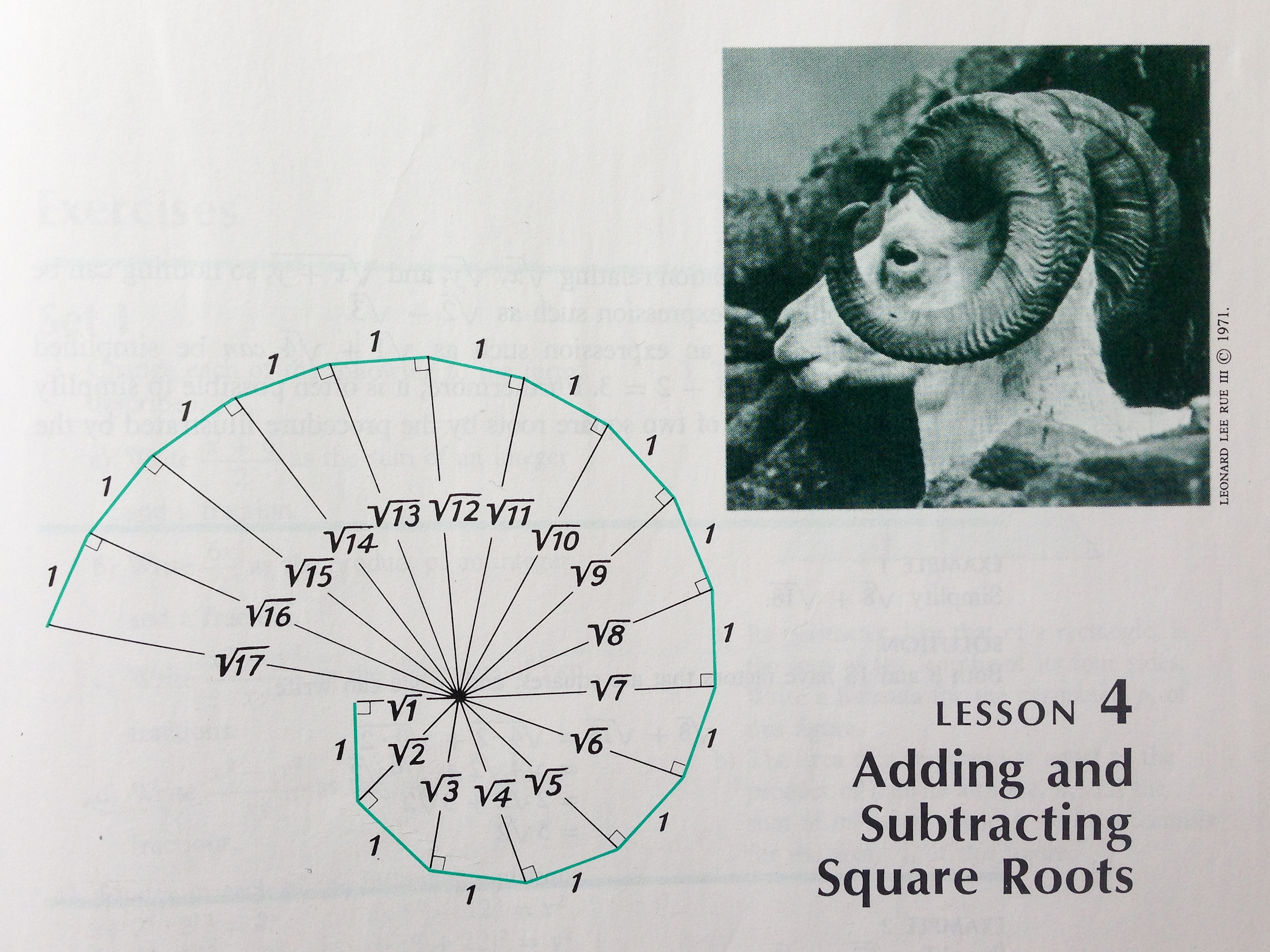
In past years I have paused for maybe a minute or so to comment on the spiral of square roots and the ram’s horn before delving into the practical part of the lesson. But this year, for some reason, I felt compelled to pause a bit longer and engage my students in a collective contemplation of this beautiful mathematical structure. I asked questions like, “What do you see? What do you like? What is interesting? To my surprise, just a few simple questions led to a pretty lively dialogue about the figure. My students’ engagement suddenly became self-sustaining, so I thought I would run with it. “Hey, let’s all try to recreate this figure on our paper.” This led to more discussion–questions like, “How shall I start?” and “What units should I use?” and “Does it even matter what we choose to represent ‘1’?” Then we compared results, and students began to imagine creating even bigger spirals that wrapped around multiple times. Before we knew it, class was over and we never even “covered” the actual lesson. But I didn’t care–my students were captured by the beauty of mathematics.
But what happened next was even more interesting. Two of my students (one of whom is the same student who asked that question about the cyclist: “Why do we have to know this?”) came up to me the next day and asked if they could have a sheet of my big flip chart graph paper. When I asked why, they answered, “We want to try to make a bigger square root spiral.” You can imagine my reaction and my response.
Soon the three of us were strategizing together on what to use as “1,” how to determine where on the paper to start the spiral so that the area of the paper would be maximized, etc. The two students were really into their little project. No, I did not ask them to do it. No, I did not offer any extra credit for a completed spiral. And no, there was nothing “real world” about this–well, that is to say, creating a spiral of square roots was not going to help them get a job some day. But, in reality, this little mathematical engagement may have been the most “realistic” math (read: most true to the nature of math) that these students had ever done.
These two students spent 15 minutes of their study hall for the next week and a half meticulously working on their spiral. One day another 8th grader asked them why they were doing it. The student who was down on the cyclist problem answered quickly, “Because it’s cool.”
You see, I think she found the spiral interesting. And in the case of the spiral, I think it’s interesting because it’s beautiful.
In classical education we are exhorted to put in front of our students things that are true, good, and beautiful and then to pretty much get out of the way. I know that this approach works, but sometimes I need to see the evidence. Well, here it is:
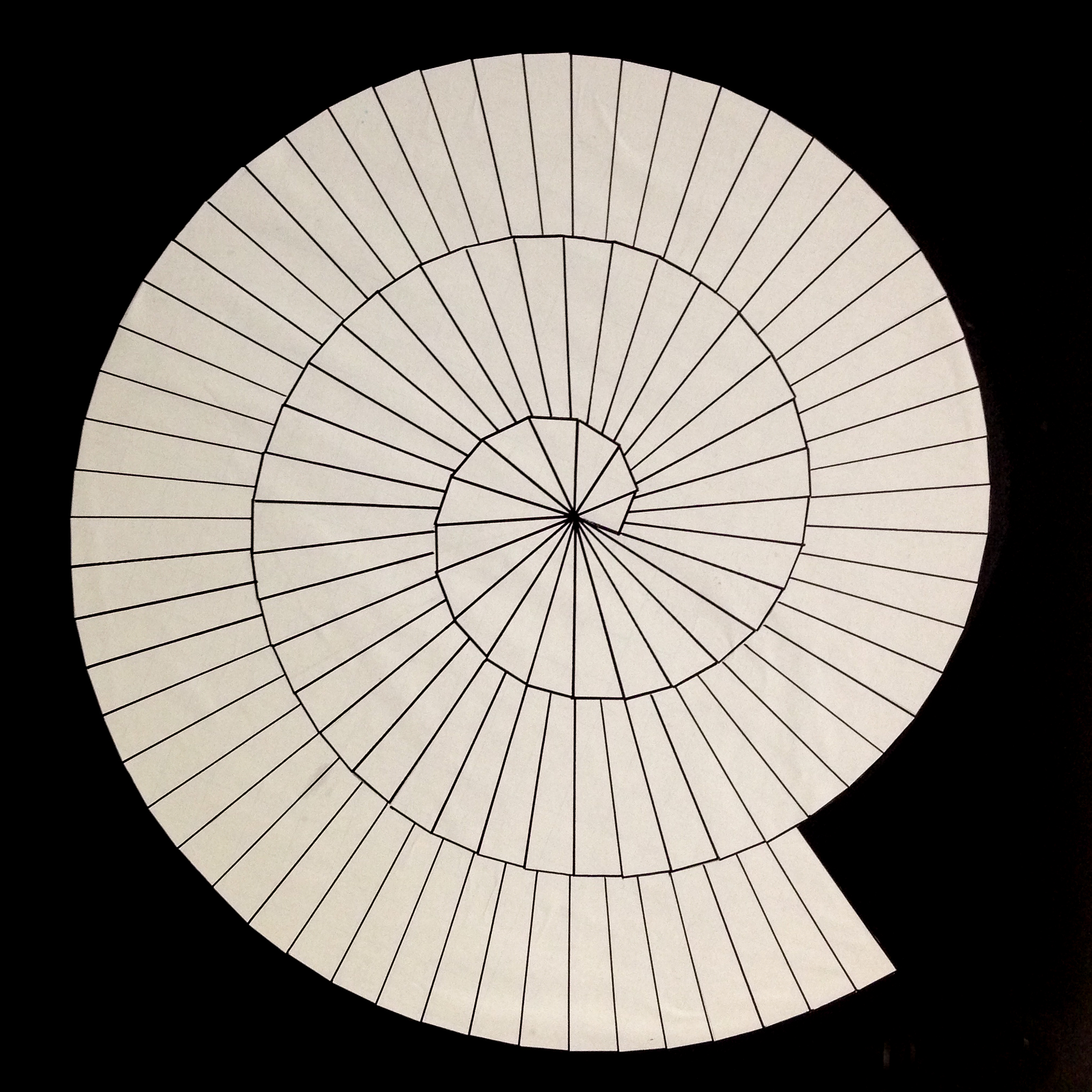
The finished product of these two students now hangs on my wall. Why? Because it is beautiful, because it is interesting (every student and adult stops, looks, and asks about it), and because it reifies for me the fruitfulness of a classical mode of teaching. That is, when we cast off the shackles of pragmatism and put in front of our students interesting ideas–true, good, and beautiful ideas–the conversation shifts from an exchange between instructor and pupil to a communion among souls fueled by a shared connection with and desire for the very Author of goodness, truth, and beauty.
What if when a student asked, “Why do I need to know this?” we could confidently answer, “Because it will change you. Because it will help form your soul.” What kind of education would that be?
Or, what if a student never felt compelled to ask this question in the first place. What if the value in what he was learning was readily apparent at the very core of his being. What kind of education would that be? I bet there wouldn’t be any tricks. I bet most textbook writers would be looking for alternate lines of work.
 Pi Alpha