
Tag Archives: Charlotte Mason

Fur Coats vs. Fir Trees: Part 2

narnia_lamppost-179px6h

A friend of mine recently sent me the following video. It’s about 10 minutes long, so if you can take the time, please watch it. I will share my thoughts below the link.

http://www.upworthy.com/the-earth-shatteringly-amazing-speech-that-ll-change-the-way-you-think-about-adulthood-4?g=2&c=cp2

I think you would agree that there are a lot of truths in this video, not least the picture that is painted of the self-centered rat race reality of so much of so many of our adult lives and how quickly dismissive we are of those around us. Perhaps you even felt convicted by some of these truths – I certainly was.

But then the crux of the message presents itself, the “alternative” to this way of interacting with the world:

“If you are aware enough to give yourself a choice, you can choose to think differently . . . it’s hard, it takes will and effort . . . but if you really learn how to think, how to pay attention, you will know you have other options. It will actually be within your power to experience a crowded, hot, slow, consumer hell type situation as not only meaningful but sacred . . . ” (emphases mine)

So what’s wrong with this approach? What’s wrong with paying attention, with making conscious choices that come as the result of right thinking? After all, Jesus tells us to pay attention or “keep awake” in not one but two parables (Matthew 24 & 25), and Paul exhorts us to “be transformed by the renewing of our minds” (Romans 12). So clearly attentiveness and right thinking are important. We take this to heart at my school where we actually train our students in the habits of attention and critical thinking.

So what is wrong with the thesis of this video? I think what is wrong is that what is presented is a near-truth, and near-truths are more dangerous than lies.

And here’s the near-truth, as I see it being presented (note this will not sound as poetic as the narrator puts forth in the video): “Your interaction with the world does not have to be this way. You just need to wake up out of your zombie state and choose to think differently. Sure it’s going to be hard, but it is within your power and will and effort to change.”

In other words, “Just man up and be a better person! It’s just a matter of choosing to change the way you think about the world.”

Oh, and by the way, the narrator calls this “real freedom,” “real education.”

But does this account accurately describe how we learn, how we change, how we are transformed, how we are “perfected” into God’s image?

Let’s say that I meet an adult who is admittedly very racist against black people. Maybe he is even consciously ashamed of this disposition, but he explains his racism by saying that he grew up in a white home in a white neighborhood where there was an obvious yet unuttered fear of black people, that he went to an all-white school that was “on the other side of town” from the nearest school that housed black kids, and that once he had a friend who was robbed at gunpoint by a black guy.

I guess I should just tell this guy, “Listen, I know this is going to be hard, but you just need to change the way you think about black people.” If he laughs incredulously at this suggestion, I just need to engage his intellect with logical arguments for why racism is evil and how it does great violence to the human soul.

I think you see my point. Again, I am not suggesting that critical, logical thinking has no place in the formation and transformation of a human soul. If that were the case, this blog and a large part of my job as a teacher would be pointless. But what ultimately forms us and our perception of the world is something much closer to our center of being, much more closely linked to what burns in our hearts and stirs in our imaginations, something that often defies logical articulation, something that has been inculcated within us due in part to our experiences, but due also to the fact that we are naturally and primarily loving, desiring beings.

And this brings us back to James K.A. Smith’s thesis which he establishes early on in Desiring the Kingdom. I will quote him again, this time from a different location and said slightly differently:

“. . . education – whether acknowledged or not – is a formation of the desires and imagination that creates a certain kind of person who is part of a certain kind of people. The facts and information learned as part of the process are always situated and embedded in something deeper that is being learned all along: a particular vision of the good life.”

The fictional (yet to some degree, if we are honest with ourselves, representative of some part in all of us that passes dismissive judgement against some class of people, rather it be because of race, religion, social standing, education, the kind of jeans she wears, etc.) racist character I created above received an “unacknowledged” or “implicit” education that painted a picture of the “good life” as “life without black people in it.”

The point is quite simply this: what seems to “stick” in a person’s core identity are those “teachings” that have been directed towards his heart and imagination, and often times this type of learning actually bypasses our conscious, thinking minds and goes straight to our “second nature.”

Said another way by Charlotte Mason, “Education is an atmosphere.”

So what does this mean for education in a Christian school? Everything. The stakes are perhaps even higher because we are Christian. Symmetry in our “being” and “thinking” is paramount. I will leave you with one last quote from Smith:

“Could we offer a Christian education that is loaded with all sorts of Christian ideas and information – and yet be offering a formation that runs counter to that vision?”
Fur Coats vs. Fir Trees: Part 1

NarniaWardrobe

I am currently reading James K.A. Smith’s Desiring the Kingdom, upon the recommendation of a colleague and friend.  I am about a third of the way through the book and I must say that it is already transforming the way I view education.  Smith’s book is one of those that you don’t even bother picking up a highlighter for, because every other sentence would be yellow.

I am sure that I will be referencing this book in probably multiple future posts, but today I want to throw out a quote from his Introduction:

“What if the primary work of education was the transforming of our imagination rather than the saturation of our intellect?  What if education wasn’t first and foremost about what we know, but about what we love?”

There is so much wrapped up in this quote that it’s hard to know where to start.

So let me pose a couple of questions: To what part of our students’ nature are we making our appeal?  Are we filling their minds or engaging their imaginations?  Are we primarily honing their intellects or is the stewardship of their hearts a priority?

The great early 20th century educator Charlotte Mason said, “The question is not, — how much does the youth know? when he has finished his education — but how much does he care?”

In Desiring the Kingdom, Smith goes on to posit that humans are by nature “desiring” beings first and foremost, rather than “thinking” beings or even “believing” beings.  What all humans desire, Smith maintains, is “the kingdom,” which most generally (i.e., not biblically) translated, means “their particular vision of ‘the good life’ or ‘human flourishing.'”  Much of the balance of the book is then spent dissecting the implications of this common desire on education, specifically Christian education.  There is much more to say about these implications, but that will have to be another post.

What I want to park on at the moment is Smith’s conclusion (informed heavily by St. Augustine and Martin Heidegger) that humans are first and foremost “desiring” beings.  Smith continues:

“It’s not so much that we’re intellectually convinced and then muster the willpower to pursue what we ought; rather, at a precognitive level, we are attracted to a vision of the good life that has been painted for us in stories and myths, images and icons.  It is not primarily our minds that are captivated but rather our imaginations that are captured, and when our imagination is hooked, we’re hooked (and sometimes our imaginations can be hooked by very different visions than what we’re feeding into our minds).” (emphases by Smith)

Again, there’s a lot we could unpack here, but I want to focus on Smith’s statements about our imaginations.  I think he suggests that the type of teaching that truly forms (and transforms) who we are is the type of teaching whose focus is trained on our hearts and imaginations, rather than solely our intellects.  In other words, what truly “sticks” in one’s soul – what truly informs how and what he will love – is what he is taught from the heart up, rather than the other way around.  And one way to get to our hearts is via our imaginations.

C.S. Lewis clearly got this.  His Chronicles of Narnia are so beloved by children and adults alike because the truths embedded in that wonderful series are aimed first at our imaginations.  And I believe that true learning – true “education,” true “drawing out” – happens when the hearts and imaginations as well as the minds of our students are engaged.  Said another way, what we are feeding the hearts and imaginations of our students (whether explicitly or implicitly), must be consistent with, must shore up what we are feeding into their minds.

I must pause here to make something very clear:  This is in no way saying that we should throw the baby out with the bath water and diminish the value of sound thinking and logic; this is certainly a both/and situation rather than an either/or.  After all, much of this blog will hopefully be aimed at “the renewal of our minds,” which I believe comes largely from engaging in intellectual discourse.  As our pastor often says, “We need to have a rigorous faith,” to think about why we believe what we believe, to engage in deep theological study, to read challenging books.

As my students will tell you, I constantly exhort them to think more critically and rigorously.  But why do they take me up on the challenge?  I think it’s because I go after their hearts and imaginations first.

But most modern (progressive) education has redefined our students as merely brain-holding containers, which must be filled, rather than spiritual, loving persons, whose natural desire to love must be stewarded.

In other words, what I think I’m saying here (and I have to believe that Smith would agree with me, or worse, find this blog and post to the comments section: “You’re just stealing my ideas and putting them in your blog!”) is that it might be more important to teach our students how and what to love than to teach them how to think or what to believe.

For those of you who teach, we’ve all had those moments in the classroom when we feel like we are just hitting a wall with our students.  Sure they may be thinking, they may be processing – and I’m going to go out on a limb here and propose that they may even be thinking rigorously –  but they are not wholly engaged.  Formation of their minds might be happening, but transformation of their souls and spirits may not be happening.  In the extreme case, they are simply becoming “more clever devils,” as C.S. Lewis would say.

But then we have those moments when we see the hearts, the true identities (the God-reflections) of our students breaking through to the surface, discussions are charged with life (not just intellectual and rigorous in thought), e ducere is really happening.  Our students are being their most human selves.  Those are the transformative moments, I believe.  And I really don’t believe those moments happen without the hearts and imaginations being involved.

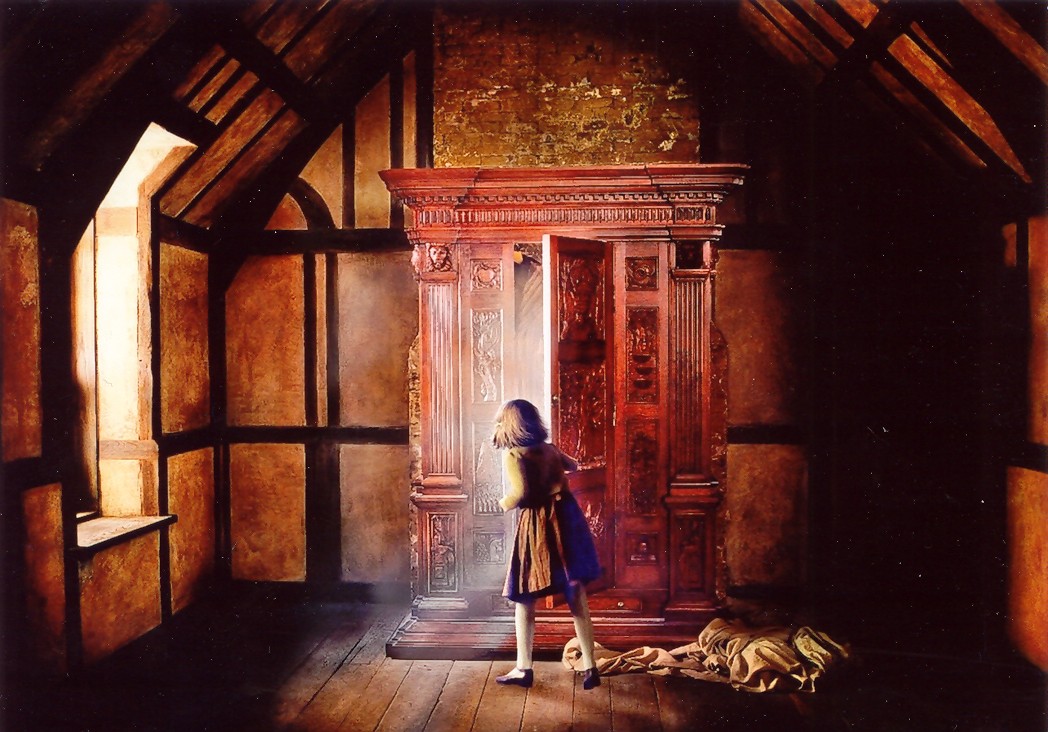
I have a good friend who teaches high school math at another Christian school in the area, and he refers to these moments as “the Narnia moments.”  “But then,” he goes on to say, “we all have those days when we just hit the back of the wardrobe.”

Like all good teachers do with good ideas learned from other good teachers, I’ve since stolen his analogy – hence my desire for my students to grasp at fir trees rather than fur coats.  If I could put an early 20th century London lamppost in my classroom I would.

So what does this mean for our teaching?  Those of you who tire of philosophical discourse and crave practical application, here it comes.

I’m talking to teachers out there now: I don’t know about you, but every teaching methodology/mode that I have read about or been taught remains in the realm of theory until I actually see it work in my classroom in this big “Aha!” moment that I almost always have to giddily share with my students.  That’s right, I share some of my teaching secrets with them – they just love being invited “behind the curtain.”

The other day I had one of those “Aha!” moments, and not because I had never used this technique successfully before, but because – for the first time, perhaps – I took notice of what I was doing and realized what was actually happening and why it was working.

So here’s what happened: every year around this time our students start practicing for an end of year performance.  It has been the tradition that the middle school students have the responsibility of setting up the risers on the stage every week for practices, and the 8th graders have the distinct honor of being the leaders of the crew.  Now why these kids love hauling heavy wooden boxes from the bowels of the sanctuary and setting them up is beyond me, but literally these practice weeks are one of the highlights of the year for them.

But this year our administration decided to get dads to do the setup (maybe the child labor laws were discovered??).  Well I had to break this (bad?) news to the 8th graders one morning, and you would have thought I had taken away P.E. class for the rest of the year.  They were up in arms.  Oh the injustice!  How could anyone dare rob them of this pure enjoyment and esteemed honor??

Well they were going on and on, which I let them do for a few minutes, as I typically like to do anytime they are airing their grievances (I mean, you learn so much about them during those few moments), but our science test was only a week away and I just had to get on with the business of teaching them vector diagrams.  But it was very clear that this type of transition was going to be nearly impossible.

Younger teacher me would have pulled the authority card and said, “Alright, alright, I get it.  You’re upset.  It’s so unfair that manual labor has been taken from you.  But we have to get to work, so take out your notes and let’s go.”  I would have then wrote on the board, in all CAPS and with deliberate and firm pen strokes, “Vector Diagrams,” underlined, of course.  Then I would have started teaching from my notes.  And sure, because my students do respect me and are very well behaved, they would have done just what I asked them to.  They probably would have even engaged their minds.  But oh, the irresolution and angst remaining in their hearts!  At this point I would have most certainly been simply dumping ideas into their brains.

And I have done just that so many times.  Students, please forgive me.

But this particular day I took a different route.  While they were still very much in the midst of their gripe session, I drew on the board a picture of a riser sitting on a stage.  My drawing skills are mediocre on the best day, but I guess they could tell what I had drawn because they quieted down and look intently and with anticipation.  “So here’s one of your risers sitting on the stage, one of the heavier ones, you know.  Now, the way I have this riser drawn, is it going to fall off the stage?”

And despite the fact that I was using rectangles to introduce vector diagrams (could it get more plain than that?), they were captivated.  No, I wasn’t resolving their dilemma of injustice, but I was still talking about those silly risers.  And the doors to their hearts stayed open, and the doors to their imaginations stayed open, and boy did we ever learn about vector diagrams that day!  I think it might have been one of the most enjoyable discussions we’ve had this semester and let’s face it: vector diagrams aren’t that particularly fascinating.

Now maybe this was just a coincidence, you say.  Or perhaps I was just leveraging the energy from their cries of injustice to fuel the discussion of an otherwise dry topic.  Maybe so.  But I can tell you this, when our vector diagrams morphed from a riser sitting on a stage into a dinosaur walking a turtle who was running after a cobra . . . well, I think there was some imagination involved – oh, and some thinking going on too.  And somehow the riser issue fizzled away naturally – well, at least for that day.