At what seemed like a teachable moment in math class earlier this week:
Me: “If you had to be completely honest, would you say that you are concerned about how well your classmates are doing in math, or are you just focused on yourself–your own understanding and performance? Be honest.”
Several students (under their breath): “Ourselves.”
Me: “Okay, good. Thank you for being honest. Now, let’s compare this to our Christian community. Should it be our concern if our fellow brother or sister is faltering in his or her faith or just generally needs some support in life at the moment? What about someone we know but whose faith we don’t know about? If they are struggling somehow in life, should we care?”
Several students: “Yes, of course.”
Me: “So how is that perspective different from how we view our learning in school?”
One student: “Actually it’s the exact opposite.”
Me: “Does it have to be that way?”
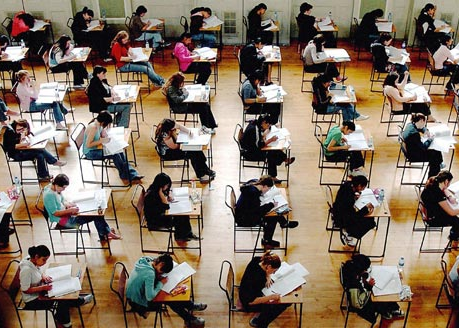
I got mostly blank looks after this question. I think a couple of students may have mumbled, “I don’t think so,” but not because they were convinced; rather I think they probably felt like that was the appropriate Sunday School response. One thing became very painfully clear, though: no one in the room had spent a lot of time, if any, imagining that the academic part of school might could (or should?) look more like true Christian community. No one had spent a lot of time worrying about how his or her classmates were doing in school.
If Jamie Smith is right when he says that “all habits and practices are ultimately trying to make us into a certain kind of person1,” then what kinds of persons are the academic climates in our schools making? In particular, what kinds of persons are the academic climates in our Christian schools making? If the answers to these last two questions are not really that different from each other, then we have a big problem (or, I guess I should say “opportunity”) in our Christian schools.
If chapel and Bible class and prayer are the only ways in which our Christian schools look different from secular schools, then I think we are completely missing the point. If we are not looking different–radically different–on the level at which the students live–in their daily reality, their economy, where they are told by the world (and us teachers) that things matter, where they are working day in and day out (and this reality in school is academics, where the currency is grades)–then we are making no difference, and actually we may be doing more harm than a secular school because we have set up a dualism that is more despicable than paganism.
Now one could make the argument that our students’ reality is actually at the level of relationships and acceptance and “likes,” and there is much truth to this and much work to be done in this arena as well. But I want to focus on the reality that our Christian schools and us teachers have most direct control over, and with which we too easily acquiesce to the modern secular culture of individualism and competition–and that is the reality of academics.
Before this tirade gets out of hand (and please know that I’m implicating myself here as well), I’ll end with a quote from Alfie Kohn:
“Lending an even more noxious twist to the habit of seeing education in purely economic terms is the use of the word “competitiveness,” which implies that our goals should be framed in terms of beating others rather than doing well. When the topic is globalization, it’s commonly assumed that competition is unavoidable: For one enterprise (or country) to succeed, another must fail. But even if this were true–and economists Paul Krugman and the late David Gordon have separately argued it probably isn’t–why in the world would we accept the same zerosum mentality with respect to learning?”2
– – – – – – – – –
1 Desiring the Kingdom: Worship, Worldview, and Cultural Formation, Jamie Smith, 2009
2 Against “Competitiveness”: Why Good Teachers Aren’t Thinking about the Global Economy, Alfie Kohn, 2007.
 Pi Alpha