Category Archives: Uncategorized

Let it Snow: Science as Bible Class

snowflake_forblogheader

In light of the recent snowy weather in Atlanta, I put together the following slideshow of snowflake images using the stunning macro-photographs from a brilliant Russian photographer, Alexey Kljatov.  (Mr. Kljatov has kindly made his photographs available to the public as long as we credit him, so please go enjoy more of his work here.  You will be blessed.)

There are plenty of technically complex (and, perhaps, more pragmatic) things we could talk about when it comes to snow–a proper exploration of the intricate phase diagram for ice crystals alone is enough to fill at least a week of class time.  But sometimes it is a good thing to remind students in a classical Christian school the primary reason we study science: not so we can go do something, but so we can better know Someone.  So I presented the following slideshow to my 6th and 8th grade science students, then asked them to write a one-paragraph response.

If you can spare the time, please take five minutes, remove yourself from distractions, quiet your soul, and watch this.  Then read some of my students’ responses below the video.

Two of my students actually had tears in their eyes at the conclusion of the slide show–does the beauty of God’s creation still move us so?

Here are some excerpts from the student responses:

“In every piece of snow God has made a masterpiece, with shapes, varying in size, depth, and design.  It shows me that God really will take care of us, because if He puts that much detail into little snowflakes, He definitely put that much detail into us.”

“The snowflakes show how precise and perfect God is.”

“Since the snowflakes are so beautiful I can’t imagine how heaven will be.”

“Just like how God has made every snowflake different, He has also made every person different.”

“The detail God has put into all of these snowflakes makes me want to know more about the wonderful things He can do.”

“If God makes something as small and unimportant as a snowflake so beautiful and complex, how much care must He put into creating us?  If he makes billions of snowflakes every second of every day and each one is beautiful and unique in its own way, how important am I in God’s eyes?”

“To see the microscopic detail in a snowflake reminded me that I am fearfully and wonderfully made.”

“I realized that the things we take for granted are the greatest things in life.”

“The snowflakes are not much different from us.  We both have the same purpose: to glorify God.”

“I noticed that most were still symmetrical, but some had begun to melt.  It was as if they were created in perfection, but as they began to be influenced by the heat close to the Earth they began to melt and lose that perfection.”

— – — – —

That last statement really stuck with me.  This student was referring to the snowflake pictured at the top of this post.

We are all snowflakes.  Not only are we “fearfully and wonderfully made,” but we still bear that image of God’s perfection, though the melting power of sin has caused us to lose true symmetry with God.

But you can still look at a snowflake that has partially melted and imagine what it must have looked like in its perfect state.

When we look at our students, do we focus on their melted edges, or do we imagine what they must look like to God once Jesus has purified them and made them, well, whiter than snow?

As C.S. Lewis once said, “There are no ordinary people.  You have never talked to a mere mortal.”

Nor do we teach them.

What do you seek?

lostcoin

“Again the next day John [the Baptizer] was standing with two of his disciples, and he looked at Jesus as He walked, and said, ‘Behold, the Lamb of God!’  The two disciples heard him speak, and they followed Jesus.  And Jesus turned and saw them following, and said to them, ‘What do you seek?’  They said to Him, ‘Rabbi (which translated means Teacher), where are You staying?’  He said to them, ‘Come, and you will see.'”     John 1:35-39a

“What do you seek?”  Such a simple, seemingly innocent, straight-forward question.

I imagine a couple of my students following me down the hallway in between classes and me turning around and saying, “Hey guys, what do y’all need?”  In other words, I must have in my possession some information that they require.  They seek my attention in order to receive some transmission of information.  “When did you say that homework was due?”  “Do we need our science books today?”  “Are we going outside for lunch today?”  “Have you seen Coach?”

Jesus, of course, was not simply asking the disciples what information they required, although they may have interpreted his question that literally (their response was, “Where are you staying?”).  We can infer that Jesus meant much more by considering His response to their question of location: “Come and you will see.”  The Greek verb for “see” used there is ὁράω or “horao,” which literally means “to see or perceive” but is often used metaphorically to mean “to see with the mind,” or “to see spiritually.” (Strong’s Concordance)  The rest of the book of John would suggest that Jesus was indeed all about opening our eyes to a new reality.

When parents go through the admissions process at our school, one of the questions we ask them is, “What are you seeking?”  I often ask my anxious 8th graders who are in the midst of applying out to high schools the same question.

I’m not exactly sure where I’m going with this, but I am left with at least three questions:

1) When parents or students “come and see” my classroom, do they find that Jesus is “abiding” there?

2) After my students have “followed me” for three years, do they leave simply having acquired more information, or have I, with obedience to and help from the Holy Spirit, helped open their eyes to Truth?

3) What am I really seeking?  How would my students answer this question about me?

Loving our Way to Truth

truthlove

It seems only fitting to start the new year off with a reminder of what matters and how it is that we might find it.  The following comes from one of Andrew Kern’s posts over on the Circe Institute site.

“For many, the quest to know the truth is a purely rational quest. Thus, for example, Rene Descartes’ resolution to begin by doubting everything – all that he was told, and everything he perceived with his senses. Only by reasoning could he come to know the truth. It’s easy to see why we would think this way. Truth is generally perceived as something we gain through intellectual endeavors. However, what is overlooked in this approach is the health and effectiveness of the truth seeking instrument. The mind interacts with and is largely controlled by the heart, soul, and spirit of the person. Therefore the most perfectly trained mind cannot find truth if the soul of the seeker is disordered. Consequently, and to the chagrin of some intellectuals, truth can only be gained by the soul that is actively loving his neighbor. If she is not doing so, then she is not healthy enough to perceive truth. Instead, she will reduce truth to something that fits within her self-determined parameters. Caritas, Agape, Charity is an infinite act. When a person begins to perform it he comes in contact with an infinite reality deep in his heart. He gains a faculty of perception for things eternal, just as he gains a faculty of perception for things geometrical when he contemplates the definitions and axioms of geometry and he gains a faculty of perception for things artistic when he contemplates and imitates works of art. Only the actively loving person can ever know the truth because the truth is love and is bound to love.”   – Andrew Kern

O Come Let Us Adore Him

Processed with VSCOcam with t1 preset

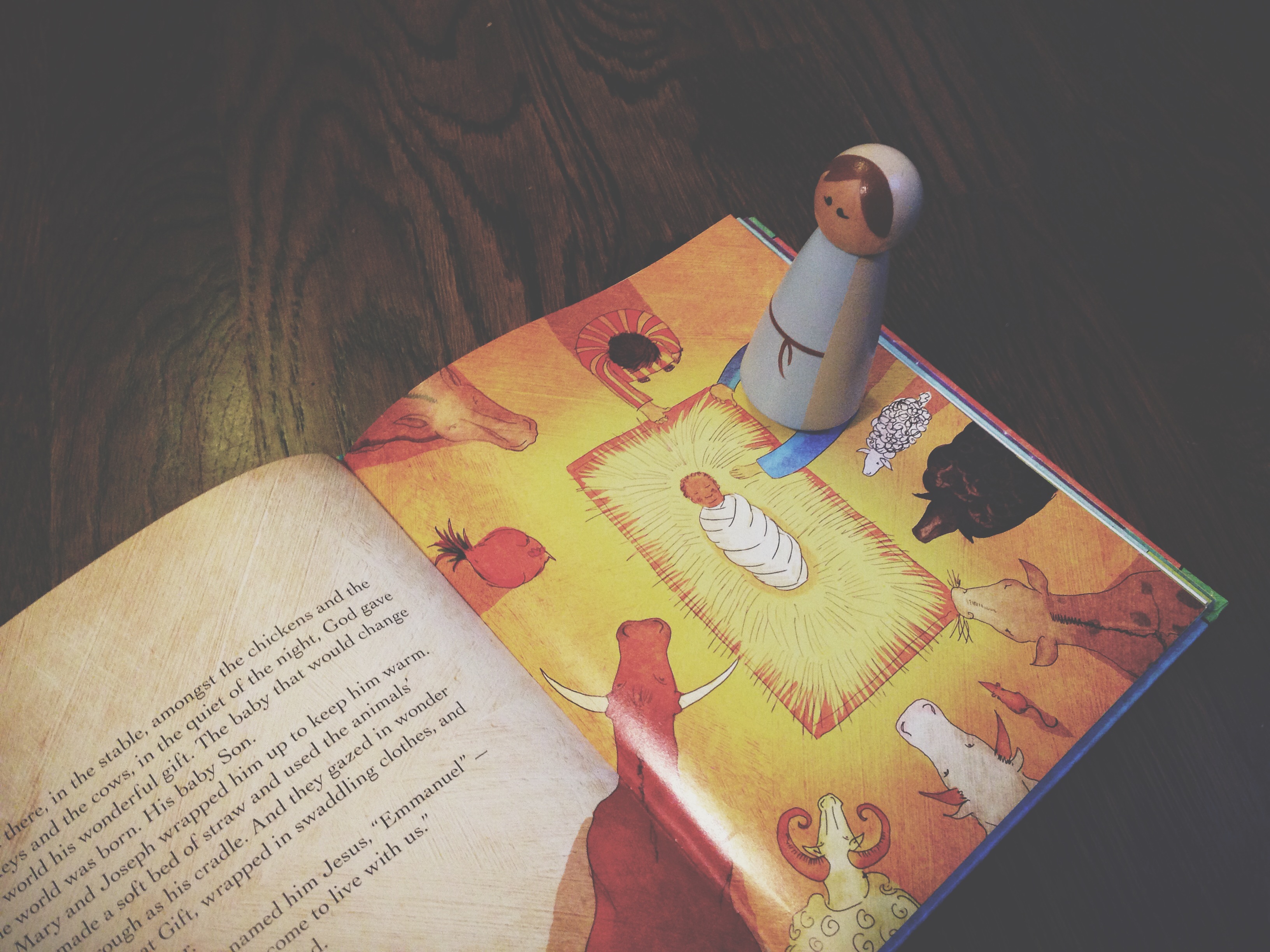
In our home we have a simple yet beautiful nativity set made of hand-painted wooden pegs.  Although our (my?  Anne probably had a better vision all along) initial intent was to create a nice little nativity display for our children to “look at but not touch,” you can probably imagine that these little wooden characters have quickly become one of the new favorite toys of the season, especially for our 2 1/2 year-old Alice.

To be honest, I was initially annoyed by finding shepherds under tables and Joseph in the bathroom, and Eleanor, our 10-month-old, could not keep the spherically-shaped sheep out of her mouth.  And who knew how much angels loved talking to Thomas the Train?

At this point in the story I could talk about how I was eventually convicted by the metaphor for faith that was made painfully obvious to me yesterday:  that we adults, we like to put the story of Jesus on a shelf, to “look at but not touch,” so that we are “reminded of God’s Truth” when we happen to glance over at the display from time to time.  Children, however, are natural integrators of faith.  They are all-in.  The characters of Jesus’ story become regular players in their world, the story of Jesus is wrapped around and through the entire tapestry of their imagination.  Why wouldn’t an angel talk to a train?  “The Kingdom of Heaven belongs to such as these . . . ”

But that’s another post.

What I want to talk about this morning is what happened two nights ago, when the little wooden Baby Jesus could not be found.  Anne and I were finishing a dinner conversation, and from the next room we could hear Alice walking around saying, “Baby Jesus, where are you?”  A few minutes later we heard, “There you go, Mommy, there’s Baby Jesus.”  And what we found in the adjacent room is pictured at the top of this post.  Alice had searched and searched for the wooden Baby Jesus to no avail, so she found the picture of the manger scene in her Jesus Storybook Bible and placed Mary (Mommy) right on top of the two-dimensional Mary on the page, and positioned her looking directly at her baby.

At the time Anne and I thought this little act was incredibly cute and special and meaningful, but the true meaning didn’t well up within me until last night at church when Anne and I sang along with our congregation, “O Come Let Us Adore Him.”

Adoration.  An often ethereal posture in my faith, I must confess.  Sure, I love Jesus, but how often do I put myself in a posture of adoration?  Do I come to adore Him, or to plead with Him, ask of Him, bargain with Him?

But Alice gets it.  She knew that Mary needed to be adoring the Baby Jesus.  And once she placed Mary in that posture, she left her alone.  The wooden Mary sat on the book adoring the two-dimensional Baby Jesus the rest of the evening (until Eleanor came along).  It’s as if Alice knew that Mary was now at peace.  “There you go, Mommy.  There’s Baby Jesus.”

Good friends, come!  Let us adore Him!

Truth is a Person

truth

We make the worst mistake in Christian education when we forget that Truth is a Person.

If we teach our students to learn from a purely objective point of view, to hold Truth (“knowledge”) at a distance, to study it in order to master it so that they can use it to get what they want out of life (good grades, good college, good job, good car, good retirement), then why do we act surprised when our students regard Jesus in the same transactional, utilitarian manner?

If our aim is to inform rather than to transform, we will graduate moralists rather than Kingdom bearers, prisoners rather than free men.

Truth After Silence

candle

[7:00 a.m. Monday morning.  Weekly Bible study with my six 8th-grade boys.  A dozen Dunkin Donuts already consumed.]

Me: “I want to spend our time this morning reflecting on one short text from the first chapter of James:  ‘Count it all joy, my brothers, when you meet trials of various kinds, for you know that the testing of your faith produces steadfastness.  And let steadfastness have its full effect, that you may be perfect and complete, lacking in nothing.‘  Thoughts?

<At least 60 seconds of silence – you know, of the uncomfortable sort>

8th grade boy: “All of us are lacking.”

Thank you, Holy Spirit.

Learning in Community

RomanSchool

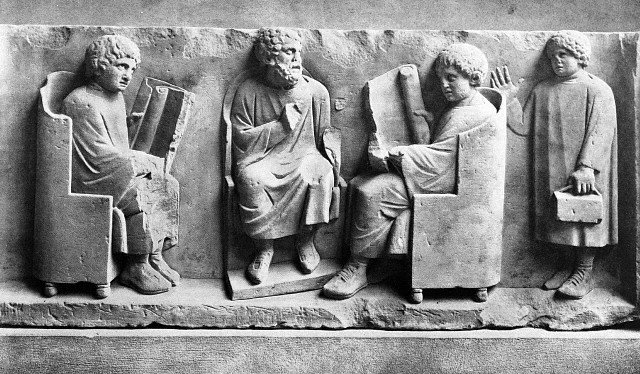
“It is no surprise that our dominant images of teaching and learning are individualistic and competitive rather than communal; they are derived from images of reality and of knowing that bear these same marks.  If reality consists of atoms in the void or individuals in competition, and if knowing consists of gathering discrete data about objects, then teaching and learning will mean delivering data to students who must compete for those scarce rewards called grades.  But what scholars now say–and what good teachers have always known–is that real learning does not happen until students are brought into relationship with the teacher, with each other, and with the subject.  We cannot learn deeply and well until a community of learning is created in the classroom.”

– Parker Palmer, To Know as We Are Known: Education as a Spiritual Journey

Confession in Community

confession

“Why is it that it is often easier for us to confess our sins to God than to a brother?  God is holy and sinless, He is a just judge of evil and the enemy of all disobedience.  But a brother is sinful as we are. He knows from his own experience the dark night of secret sin.  Why should we not find it easier to go to a brother than to the holy God?  But if we do, we must ask ourselves whether we have not often been deceiving ourselves with our confession of sin to God, whether we have not rather been confessing our sins to ourselves and also granting ourselves absolution . . . Who can give us the certainty that, in the confession and the forgiveness of our sins, we are not dealing with ourselves but with the living God?  God gives us this certainty through our brother.  Our brother breaks the circle of self-deception.  A man who confesses his sins in the presence of a brother knows that he is no longer alone with himself; he experiences the presence of God in the reality of the other person.”

– Bonhoeffer, Life Together: The Classic Exploration of Faith in Community

“Knowing is Loving”: Part 2

knowledgepuffeth

Continuing from my previous post . . .

My whole approach to education as a student all the way through graduate school (and, if I’m honest, the first few years of my teaching career) was to collect (disperse) knowledge so that I (my students) could “coerce the world into meeting my (their) needs.”

As it turned out, I lacked a deep understanding of what my needs really were, “to known as I am known.”  This uncharitable pursuit of knowledge eventually led to the death of my spirit.  Mercifully, God saw fit to redeem me from that pit, but I would prefer that my students not require that type of epistemological journey to land them back on the path of flourishing that God intends for them.

But this brings up the question of how much of my students’ path toward flourishing is really up to me (and I ask the same thing for my own two children).  In my feeble attempts to teach them how to love and to know lovingly, I often tend to rely too much on my own efforts and influence.  In other words, I’m just trying to control another outcome.

It is at this point that my faith in God’s providence for my students must provide a hope that surpasses what I can muster by my own efforts.

And, ultimately, it is at this point that I need to stop “conveying knowledge” and start loving.

“Knowledge puffs up, but love builds up.  Anyone who claims to know something does not yet have the necessary knowledge; but anyone who loves God is known by him.”
– 1 Corinthians 8: 1b-3