Category Archives: Uncategorized

Natural Philosophy

boyleairpump

“For the wise men of old the cardinal problem had been how to conform the soul to reality, and the solution had been knowledge, self-discipline, and virtue. For magic and applied science alike the problem is how to subdue reality to the wishes of men: the solution is a technique; and both, in the practice of this technique, are ready to do things hitherto regarded as disgusting and impious.”    – C.S. Lewis, The Abolition of Man

I am at the Society for Classical Learning’s Alcuin retreat up in Grand Rapids, MI this week where the topic is “science and theology.”  Pre-meeting conversations and readings have already been such an inspiration.  I’m hoping to learn how better to, in the words of one of my fellow colleagues here, “move from teaching students to be scientists–technicians of science–to being natural philosophers: those who seek wisdom in the natural order of Creation.”

More to come . . .

Educating Toward a Long View

“A great many people seem to have voted for information as a safe substitute for virtue, but this ignores–among much else–the need to prepare humans to live short lives in the face of long work and long time.”

– Wendell Berry, People, Land, and Community

For my Class 8 Graduates

The Real Work

It may be that when we no longer know what to do
we have come to our real work,

and that when we no longer know which way to go
we have begun our real journey.

The mind that is not baffled is not employed.

The impeded stream is the one that sings.

 — Wendell Berry

Graduates, as you prepare to venture out into an unknown land, where there will be many paths to choose from, you will certainly find yourself in places where you don’t know what to do or which way to go.  I pray that you will seek your Lord God’s guidance and remain in Him during these times.  Remember our classroom credo: Quae nocent docent.  In your weakness, Christ’s power within you is made perfect.  And like that singing stream, you know your source and you know your ultimate destiny.

The rocks are coming, graduates.  May your song be a blessing to the Lord.

Crossing the Finish Line: Two Ways (Part 2)

livingwater1

I didn’t intend on making this a two-part post, but by God’s providence our sermon in church this morning picked up right where I left off in the last post and has added even more clarity to my perspective on finishing well.

One of our teaching pastors, Ashley Matthews, preached on a daunting lectionary passage from the book of Acts: the stoning of Stephen.  I think I’ll include the text here in its entirety:

“When the members of the Sanhedrin heard this, they were furious and gnashed their teeth at him.  But Stephen, full of the Holy Spirit, looked up to heaven and saw the glory of God, and Jesus standing at the right hand of God.   ‘Look,’ he said, ‘I see heaven open and the Son of Man standing at the right hand of God.’  At this they covered their ears and, yelling at the top of their voices, they all rushed at him, dragged him out of the city and began to stone him.  Meanwhile, the witnesses laid their coats at the feet of a young man named Saul.  While they were stoning him, Stephen prayed, ‘Lord Jesus, receive my spirit.’  Then he fell on his knees and cried out, ‘Lord, do not hold this sin against them.’  When he had said this, he fell asleep.”    Acts 7:54-60

Prior to this scene, Stephen had just ticked off the members of the Sanhedrin, comparing their current disobedience and betrayal/murder of Jesus to that of their ancestors who, despite being delivered out of slavery, yearned for Egypt, turned away from God, and worshipped a golden calf.  With gnashing teeth, plugged ears, and yelling voices they stoned Stephen to death.  They even took their coats off so they could throw that much harder.

But Stephen blessed them, even as he breathed his last breath.

The immediate application, I admit, I found a bit elusive.  “Where is Ashley going to take this?” I thought.  After all, we don’t get stoned to death these days for standing up for our beliefs (at least in the U.S.), and surely–no matter how tough life gets–I can’t compare any trial to the experience of being gradually and painfully murdered.  Is this where I feel guilty for ever whining or complaining about my life?  I mean, it’s not like people are ever trying to kill me by hurling rocks at my face.

No one who needs encouragement ever wants to be told, “Listen, it could be much worse!  Suck it up!”

However Ashley didn’t focus on the stoning of Stephen.  Rather, she focused on Stephen himself.

But Stephen blessed them, even as he breathed his last breath.

How in the world was this possible?  We are told how.  Stephen was “full of the Holy Spirit,” and in the previous chapter, described as “a man full of God’s grace and power.”  Like that tomato plant that turns its face to the sun because it knows of no other way to be, Stephen blessed his murderers because that is the nature of a man who is filled by God.  Said another way, if God is what fills you, then God is what comes out when you are squeezed.

How does this connect to finishing well?  Ashley quoted from an author whose name currently escapes me, but, to paraphrase, she said:

“Our culture lives in a reverie of lack.  As soon as our feet hit the floor, we think, ‘I didn’t get enough sleep.’  As soon as we step out of the shower, we think, ‘I don’t have enough time.’  As soon as we get into our car, we think, ‘I don’t have enough gas.’  We start and live every day in a deficit.”

I don’t know about the reader, but Ashley described exactly how I feel this time of year.

And why is this?  Jeremiah and C.S. Lewis would say because we are desperately trying to fill those broken cisterns; we are refusing that vacation by the sea and instead are complacent to wallow in the mud.  We desire too little.  Our expectations of Jesus are anemic.  We want control of the wheel even though we’re careening off a cliff.  And thus we find ourselves in a perpetual deficit, simply because we do not ask expectantly for something completely different.  Living water is available to us; we choose to stare into a dark well.

Lord, change my expectations, transform my desires.  Help me to ask boldly for the fullness of your Holy Spirit and, out of an unexpected abundance, may I bless those around me.

Crossing the Finish Line: Two Ways (Part 1)

finishline

For teachers and students alike, the month of May is often approached with a “just try to get through it” mentality.  (If you’re an 8th grader about to graduate middle school, perhaps you’re just on autopilot trying to coast in for a landing.)  We are all tired, and for good reason.  Hopefully we have “run the race so as to win,” which necessarily means we’re going to be nearly out of breath as we cross the finish line.

But there is a “good tired” and a “bad tired.”  In an actual race, I have experienced that “bad tired” when, after crossing the finish line, I literally thought I was going to die AND not because I had just run the race of my life.  In fact, those types of finishes are often preceded by a painful several miles that either proved to me that I had not properly prepared or that my heart wasn’t really in it.  The collapse across the finish line is just the nail in the coffin.

Then there have been those “good tired” finishes: my body still cries out in pain as I sprint past the time clock, but I am immediately invigorated by a sense of accomplishment and healthy pride because I have indeed run a good race.  Somehow my legs don’t feel like jelly and there is still a bounce in my step.

I also feel “good tired” after a long Saturday of hard manual labor out in the yard.  Every muscle in my body aches, but the pain is almost satisfying–a “good pain,” we might say.  Those are the nights that I sleep more soundly than ever.

But I can feel “bad tired” after a long day at school during which I have been impatient with students, uninspiring in my teaching, and uncharitable with my coworkers.  I come home and the loud voices of my two little girls immediately annoy me.  I want to go stare at a wall or fall asleep at 7 p.m.  But those nights of sleep are not characterized by peace.

You see, good work–work that is pleasing to and dependent upon the Lord, work that is excellent–is tiring, but it leads to a state of restfulness.  Perhaps that is what God was trying to show us in the Genesis story.  God worked.  He said, “It’s good.”  Then He rested.

But work not done well–work that is done not as unto the Lord, work that relies on our own strength–is both tiring and leaves us feeling restless.  I think of Solomon’s words in Ecclesiastes:

“Then I looked on all the works my hands had done, and on the labor in which I had toiled, and indeed all was vanity . . . There was no profit under the sun.”

So how do we finish well?  The words of Jeremiah, quoted in a recent sermon, have been resonating in my bones for the past couple of weeks:

“My people have committed two sins: They have forsaken me, the spring of living water, and they have dug their own cisterns, broken cisterns that cannot hold water.”

Does the prophet not sum up the essence of all sin–all bad finishes–in this one sentence?  Not only is the cistern a less preferred source from which to retrieve drinking water (standing water versus flowing water), we can’t even make cisterns that hold water.  As our bishop said to our congregation at a recent church retreat, “We are all leaky buckets.”

When these last few weeks of school get tough for me, my tendency is not necessarily to neglect God altogether.  On the contrary, I often find myself crying out to Him.  But what I have come to realize is this: I’m just crying out for Him to pour water into my broken cistern.

If we are going to finish well, we have to dive into that spring of living water.  We have to expect more from God than water in a leaky bucket.  As C.S. Lewis says, “Our Lord finds our desires not too strong but too weak . . . [We are] like an ignorant child who wants to go on making mud pies in a slum because he cannot imagine what is meant by the offer of a holiday at the sea.”

For me this means I can’t just ask God to pass me a cup of water as I run frenetically towards the finish line.  (Have you ever tried to drink from those little plastic cups as you’re stumbling dizzyingly through that last mile of a poorly run race?)  Also, I can’t go do work “just to get it done,” with the promise of summer vacation my reward.

Rather, I have to begin–each day–by going to where God is, sitting down, and letting Him fill me.  I have to ask boldly and expectantly.  I have to desire His will for that day.  Then I must get up, go do good work, and expect to be simultaneously exhausted and at peace at the end of the day.

May it be so.  Lord, help me.

Stand with Me

tomato-seedling-400x300

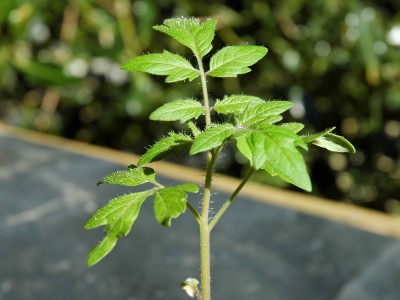
I am first and foremost an introvert, even though God has called me to a line of work that necessitates my energetic interaction with middle school students for seven hours a day.  So my early morning walks through my backyard garden, just as the dim glow of virgin gold on the eastern horizon begins to swallow the night, started as simply a retreat into solitude before the bustling activity of my school day began.  I also enjoy surveying my little plot of land: pruning a wayward tomato vine here, pulling off a sated snail there, gently watering a fragile seedling, or simply admiring the fleeting beauty of the microscopic dew drops suspended on the fuzzy foliage of sleeping vegetation.

Then one day I realized that these walks were changing me, and not just because they provided my introvert self with a few coveted moments of silence and solitude.

I inspect each of the six of my young tomato plants on these morning walks, crouching down to really have a look at them.  This time of year, just starting to outgrow his seedling stature, one of these plants measures a mere one foot tall with a stem less than half an inch in diameter.  Delicate but well-rooted, he stands upright–as if on his tiptoes–reaching toward the location of the early afternoon sun, anticipating its not-yet-begun daily journey in a shallow arc across the spring sky.

And each morning there is a bit of excitement and what I can only describe as reassuring joy when I see that little plant still standing after a long, dark night–I imagine that this is how I felt as a very young child, when I discovered that my favorite book ended the same way the second and third time through.  And I think to myself, “Like this he stood all through the night, expectant and hopeful of the next day’s sunlight, waiting patiently and without movement.  Like this he stood all through the night.”

There is just something about that tomato plant: his frailty, his complete dependence on the sun for life, and the fact that he stands in anticipation with a hope that carries him through the night–every night–looking toward that spot in the sky where the sun will shine most intensely upon his face . . . and he does all of this, not because he thinks to do so, but because he is created to do so.  He must behave this way–he knows of no other way to be.

There is just something about that tomato plant that calls to my soul.  He whispers to me, “Stand with me.”  And so I do–for a moment–until I see another snail.

Spring Confession

spring1

“And what is the object of my love?  I asked the earth and it said: ‘It is not I.’  I asked all that is in it; they made the same confession.  I asked the sea, the deeps, the living creatures that creep, and they responded: ‘We are not your God, look beyond us.’  I asked the breezes which blow and the entire air with its inhabitants said: ‘Anaximenes was mistaken; I am not God.’  I asked heaven, sun, moon and stars; they said: ‘Nor are we the God whom you seek.’  And I said to all these things in my external environment: ‘Tell me of my God who you are not, tell me something about him.’  And with a great voice they cried out: ‘He made us.’  My question was the attention I gave to them, and their response was their beauty.”

St. Augustine, Confessions, Book X.vi (9)

Education: Two Ways

pathwoods

“The difference between a path and a road is not only the obvious one.  A path is little more than a habit that comes with knowledge of a place.  It is a sort of ritual of familiarity.  As a form, it is a form of contact with a known landscape.  It is not destructive.  It is the perfect adaptation, through experience and familiarity, of movement to place; it obeys the natural contours; such obstacle as it meets it goes around.  A road, on the other hand, even the most primitive road, embodies a resistance against the landscape.  Its reason is not simply the necessity of movement, but haste.  Its wish is to avoid contact with the landscape; it seeks so far as possible to go over the country, rather than through it; its aspiration, as we see clearly in the example of our modern freeways, is to be a bridge; its tendency is to translate place into space in order to traverse it with the least effort.  It is destructive, seeking to remove or destroy all obstacles in its way.  The primitive road advanced by the destruction of the forest; modern roads advance by the destruction of topography.

“That first road from the site of New Castle to the mouth of the Kentucky River–lost now either by obsolescence or metamorphosis–is now being crossed and to some extent replaced by its modern descendant knows as I-71, and I have no wish to disturb the question of whether or not this road was needed.  I only want to observe that it bears no relation whatever to the country it passes through.  It is a pure abstraction, built to serve the two abstractions that are the poles of our national life: commerce and expensive pleasure.  It was built, not according to the lay of the land, but according to a blueprint.  Such homes and farmlands and woodlands as happened to be in its way are now buried under it.  A part of a hill near here that would have caused it to turn aside was simply cut down and disposed of as thoughtlessly as the pioneer road builders would have disposed of a tree.  Its form is the form of speed, dissatisfaction, an anxiety.  It represents the ultimate in engineering sophistication, but the crudest possible valuation of life in this world.  It is as adequate a symbol of our relation to our country now as that first road was of our relation to it in 1797.”

– Wendell Berry, A Native Hill, taken from The Art of the Commonplace: The Agrarian Essays of Wendell Berry (all emphases mine)

Berry is not talking explicitly about classical versus modern education here, but couldn’t he be?

“Why Do I Need to Know This?”

STEM1

My students will tell you that I’m not a huge fan of textbooks.  Maybe it’s the way in which they compartmentalize information and predigest big, rich ideas into bite-size, tasteless chunks (also, I can’t stand tapas restaurants).  Maybe it’s because I didn’t write any of them and I tend to have issues (perhaps to some extent noble, but perhaps also indicating a need for growth in the area of humility) whenever someone tells me how I’m supposed to teach something.  Maybe it’s because there are really very few “good” textbooks out there and most are published by companies that are just trying to make money off school systems that think 1) spending money is the best (only?) way to improve education and 2) spending money on something brand new, especially a magic, cure-all curriculum, is a guaranteed way to improve education.  Every now and then you get someone who really knows his content area and also knows how to write and who wants to publish a textbook that will bless students instead of insult them (John Mays’ science texts immediately come to mind), but these cases are, I fear, few and far between.

But this post was not meant to be a manifesto against textbooks, per se.  Instead, I want to explore the possibility that students are not as easily fooled as textbook writers (or, yes, we teachers) think they are.  The “tricks” that textbook writers use to “get students interested” simply aren’t working.  And why do we feel we need to “trick” students into learning math in the first place?

The textbook I use for Algebra is a “classic” by modern textbook standards, written by Harold Jacobs before I was born (think early 70s).  Although it is by no means an ideal textbook (does such a thing exist?), Jacobs’ Algebra text is what I would consider a “good” one for multiple reasons:

1) It is not laden with colorful and jazzy pictures of kids on skateboards in an attempt to distract students into thinking that these “rad” kids like math so they should too (apparently math + science = smiling kids on skateboards or roller coasters).

2) Jacobs takes the time over and over again to draw parallels between algebraic manipulations and fundamental arithmetic manipulations, pointing back to the basic properties of numbers which logically and necessarily allow for what we teachers have the tendency to present as the axiomatic “rules” of algebra.

3) The text is straight-forward and appropriately, well, mathematical in its presentation of concepts; gimmicks are few and far between.

4) Jacobs has a good sense of humor and he often uses Peanuts cartoons as thematic headers at the beginning of a new section.

5) In several sections, Jacobs begins with a story or some interesting example from nature or history or the then pop culture to introduce a new concept (apparently he worked closely with Martin Gardner to get some of his ideas).

To be fair, these types of introductions work well sometimes and sometimes they are a stretch.  For example, he introduces simultaneous equations by stating the height of the world’s tallest man in terms of the height of the world’s shortest man–the students always seem to love this (of course the included pictures of the two men help).  He introduces the concept of functions by talking about the relationship between the outside temperature and the rate at which crickets chirp.  This one also goes over well with the students.

It is not too often that I start a lesson in math by reading from the text, but when Jacobs provides a particularly interesting or well-articulated introduction, I will sometimes have the students read aloud from the textbook.

But here’s one that didn’t quite work.  And it’s worth exploring why.  (I should note here that I am not lumping Jacobs in with most textbook writers who peddle mathematical quackery, I’m just picking on this one example to make a point.)  Although the textbook narrative starts with a little history behind the first bicycle (with a picture, from which it is easy to see how easily this first bike would have tipped over), the text quickly moves to this statement:

“The greatest speed at which a cyclist can safely take a corner is given by the formula

bikeequation

in which s is the speed in miles per hour and r is the radius of the corner in feet.  What is the radius of the sharpest corner that a cyclist can safely turn if riding at a speed of 30 miles per hour?”

At this point in our reading, I interjected with, “So tell me students, what should we be thinking right now?”  I was looking for an answer like, “The variable we need to solve for is under a radical sign!”

Instead, I received this answer: “Why do I need to know this?”

I laughed.  But the student wasn’t trying to be cute or funny; it was an honest, sincere response, said with a straight face.  What the student meant specifically was, “Why do I need to know the sharpest corner a cyclist can safely turn at a speed of 30 miles per hour?”  And, let’s be honest, that’s a great question.

The pragmatic role education has taken on since, perhaps, the advent of the Industrial Revolution (but maybe even earlier than that), has caused mathematics instruction to deform into a “job training” or “real world preparation” class instead of an opportunity to stretch and inspire minds with beauty.  The whole STEM push is clear evidence of this unfortunate metamorphosis of purpose (just look at the graph at the top of this post).  So textbook writers and teachers alike think they must put in front of students “real world” examples or, at the very least, examples that imply a sense of necessity, in order to get students to learn math (I think progressive education has all but given up the ghost on getting students to like math).

One of my math education heroes, Dan Meyer, frequently discusses on his blog our failed attempts as math teachers or textbook writers to trick students into doing math by using “real world” examples, which end up either not actually being realistic (and the students aren’t being fooled into thinking they are) or, despite perhaps being a plausible “real world problem,” the students simply don’t find the problem interesting.  (Who cares how two separate investments are going to grow or what percent of my home value my property taxes come out to be?  My dad doesn’t even pay me to cut the backyard!)

And there’s the rub, right?  When an idea is naturally interesting, the idea itself inspires the student, without the teacher or textbook writer even needing to dress it up.  And the field of mathematics is chock full of beautifully interesting ideas.

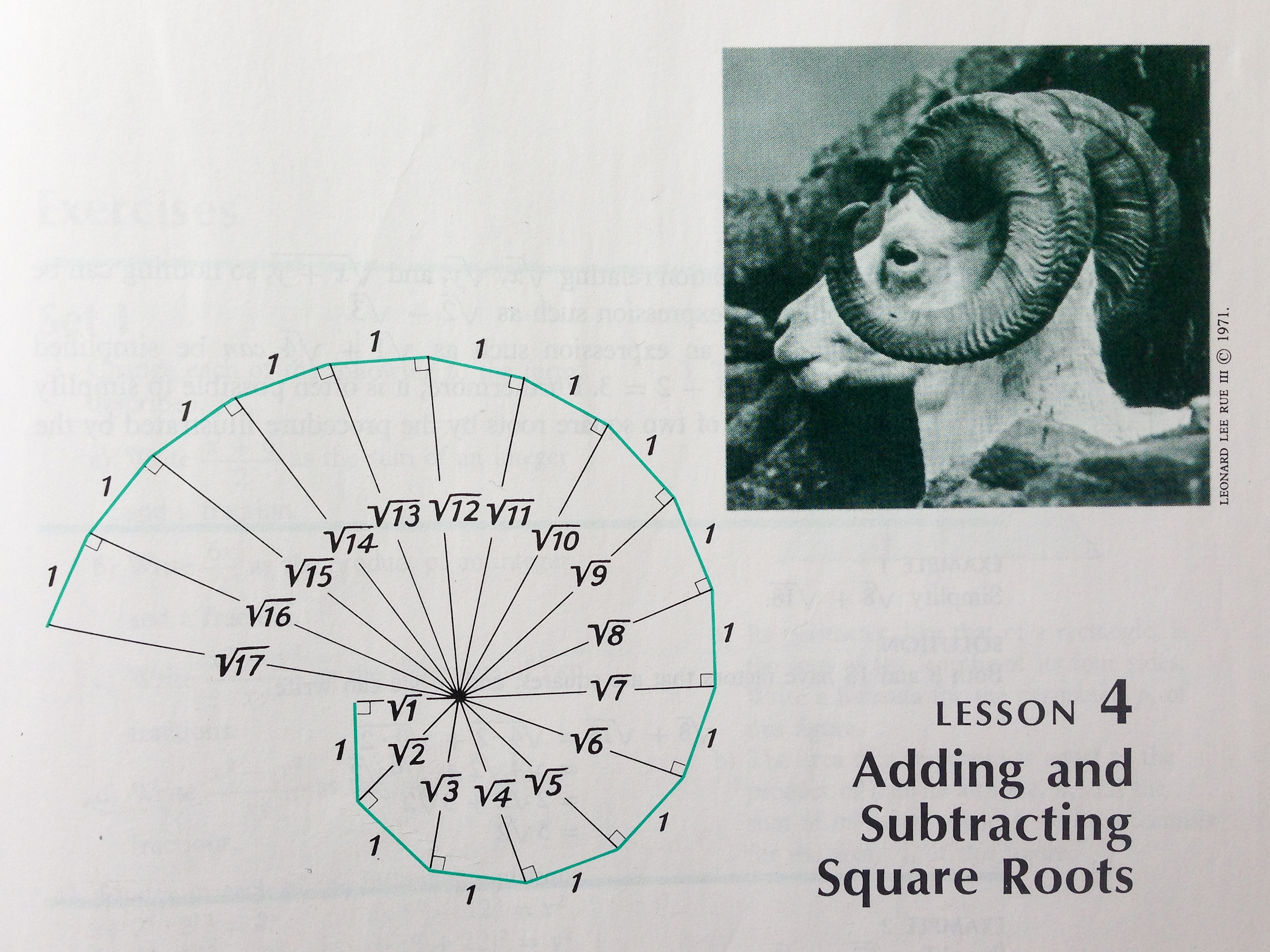
Let’s go back to my algebra class now, just a week before the turning cyclist lesson.  On this particular day we started the lesson again by referring back to Jacobs.  This is what appeared at the top of the page:
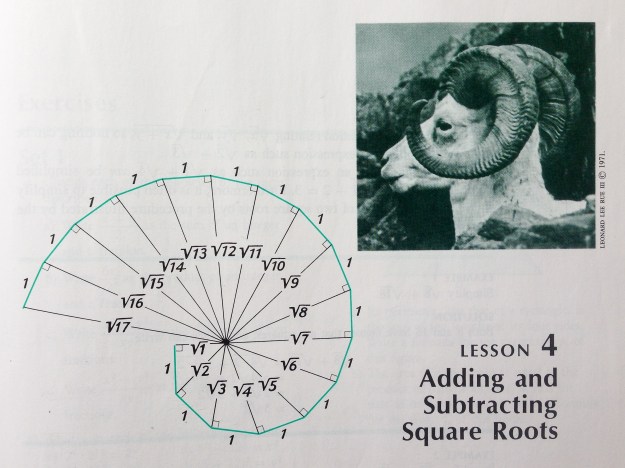
ram1-2

In past years I have paused for maybe a minute or so to comment on the spiral of square roots and the ram’s horn before delving into the practical part of the lesson.  But this year, for some reason, I felt compelled to pause a bit longer and engage my students in a collective contemplation of this beautiful mathematical structure.  I asked questions like, “What do you see?  What do you like?  What is interesting?  To my surprise, just a few simple questions led to a pretty lively dialogue about the figure.  My students’ engagement suddenly became self-sustaining, so I thought I would run with it.  “Hey, let’s all try to recreate this figure on our paper.”  This led to more discussion–questions like, “How shall I start?” and “What units should I use?” and “Does it even matter what we choose to represent ‘1’?”  Then we compared results, and students began to imagine creating even bigger spirals that wrapped around multiple times.  Before we knew it, class was over and we never even “covered” the actual lesson.  But I didn’t care–my students were captured by the beauty of mathematics.

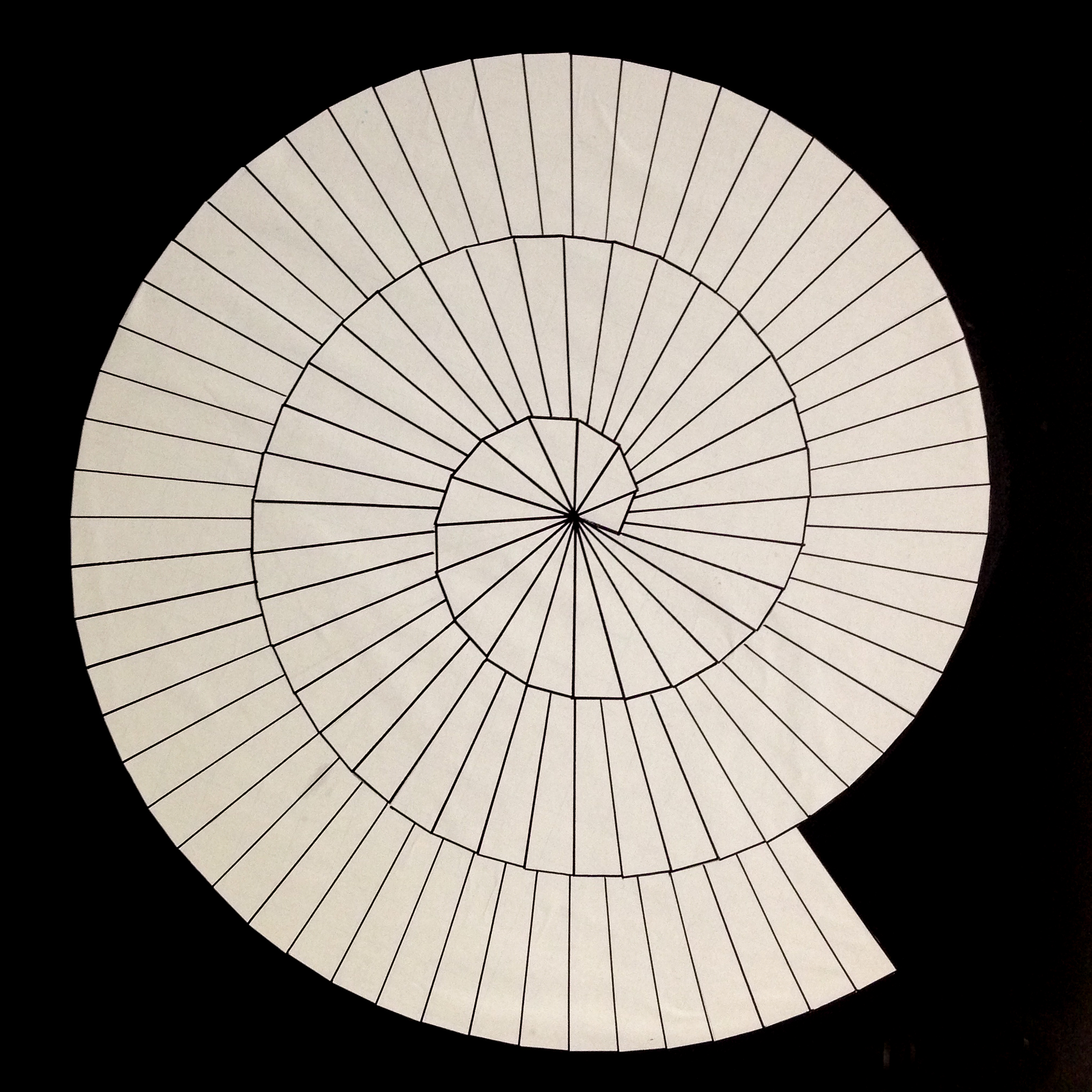
But what happened next was even more interesting.  Two of my students (one of whom is the same student who asked that question about the cyclist: “Why do we have to know this?”) came up to me the next day and asked if they could have a sheet of my big flip chart graph paper.  When I asked why, they answered, “We want to try to make a bigger square root spiral.”  You can imagine my reaction and my response.

Soon the three of us were strategizing together on what to use as “1,” how to determine where on the paper to start the spiral so that the area of the paper would be maximized, etc.  The two students were really into their little project.  No, I did not ask them to do it.  No, I did not offer any extra credit for a completed spiral.  And no, there was nothing “real world” about this–well, that is to say, creating a spiral of square roots was not going to help them get a job some day.  But, in reality, this little mathematical engagement may have been the most “realistic” math (read: most true to the nature of math) that these students had ever done.

These two students spent 15 minutes of their study hall for the next week and a half meticulously working on their spiral.  One day another 8th grader asked them why they were doing it.  The student who was down on the cyclist problem answered quickly, “Because it’s cool.”

You see, I think she found the spiral interesting.  And in the case of the spiral, I think it’s interesting because it’s beautiful.

In classical education we are exhorted to put in front of our students things that are true, good, and beautiful and then to pretty much get out of the way.  I know that this approach works, but sometimes I need to see the evidence.  Well, here it is:
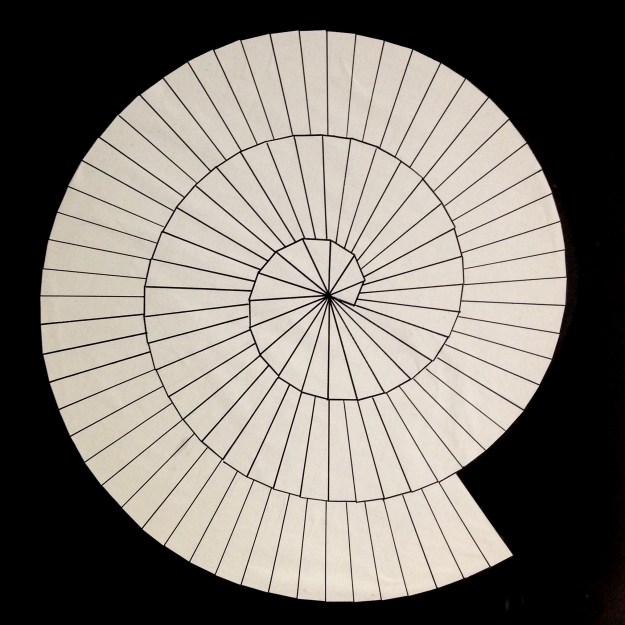
ram2-2

The finished product of these two students now hangs on my wall.  Why?  Because it is beautiful, because it is interesting (every student and adult stops, looks, and asks about it), and because it reifies for me the fruitfulness of a classical mode of teaching.  That is, when we cast off the shackles of pragmatism and put in front of our students interesting ideas–true, good, and beautiful ideas–the conversation shifts from an exchange between instructor and pupil to a communion among souls fueled by a shared connection with and desire for the very Author of goodness, truth, and beauty.

What if when a student asked, “Why do I need to know this?” we could confidently answer, “Because it will change you.  Because it will help form your soul.”  What kind of education would that be?

Or, what if a student never felt compelled to ask this question in the first place.  What if the value in what he was learning was readily apparent at the very core of his being.  What kind of education would that be?  I bet there wouldn’t be any tricks.  I bet most textbook writers would be looking for alternate lines of work.
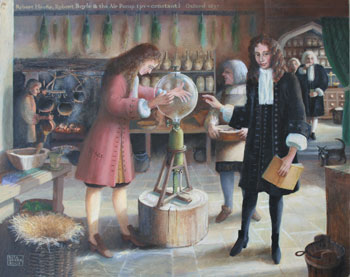
Socrates at Starbucks

socratucks

While grading papers at a coffeehouse and emailing back and forth with my best friend and fellow math teacher, “The Swam,” we had the following exchange:

Me:  “There’s an article to be written about how much teachers typically hate grading.  Why don’t I look at grading with genuine eagerness, considering this my opportunity to coach and refine my students, rather than a usually painful, avoided-at-all-costs add-on ‘requirement’ of my job that takes away from the part of my job that I actually love?”

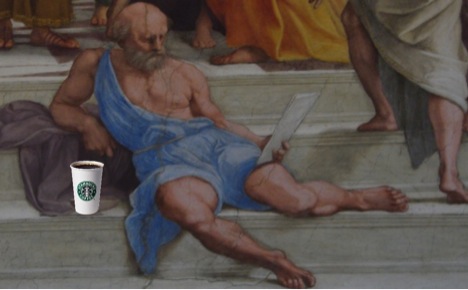
The Swam:  “That’s a silly article.  Grading sucks because in an ideal world we wouldn’t take papers away from our instruction, we’d do all the reciprocal assessment we needed in conversation with our students.  Grading papers is the result of a broken system.  Do you think Socrates sat around coffeehouses grading papers?”

The Swam has a point.  A good point, in fact.  In so many ways we are so many mutations down the line of brokenness in this thing we still call “education” that we miss the point when we try to “do the wrong thing better,” or at least with a better attitude.  Perhaps the appropriate analogy is trying to figure out how better (and more joyfully) to use a hammer to cut a board in half, when all the while we have forgotten about the saw we’re supposed to be painting a wall (see, I did it again).