Like most teachers I enjoy a good rabbit trail every now and then – okay, perhaps more often than I should. By 8th grade my students know me well enough and are smart enough to know just which rabbits I will chase, and they throw them out at me with great frequency. Since I teach my 8th graders three different classes – some days for three periods in a row – rabbit trails are not only common but often a welcomed diversion.
One of the classes I teach to 8th graders is Physical Science. In a discussion about molecules and their various levels of complexity the other day, we were exploring the intriguing diversity of carbon molecules. A simple rearrangement of the carbon atoms in a purely carbon molecule results in a substance with completely different properties. Arrange the carbon atoms in layers of two-dimensional hexagonal lattices and you have graphite. Arrange the exact same atoms in a three-dimensional octahedral lattice and you have a diamond.
Of course, the next question was: “What other shapes can carbon atoms make?” In other words, are there other allotropes of carbon that make for interesting shapes and interesting substances?
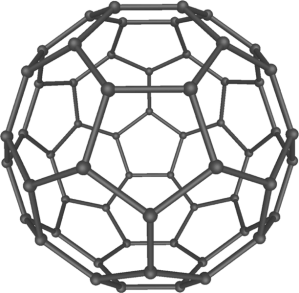
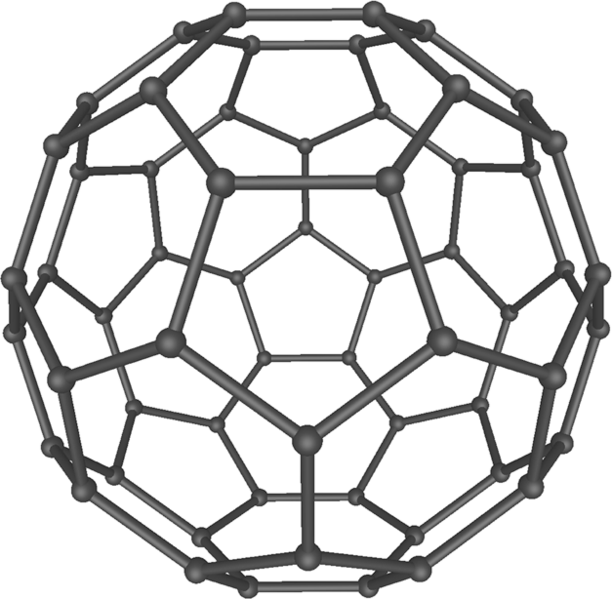
And I couldn’t resist talking about buckminsterfullerene, or “buckyball,” as it is more colloquially referred to in the scientific community. (Not to be confused with the spherical magnetic toy “buckyball,” which has been discontinued due to safety concerns. Apparently kids were swallowing these really powerful magnets and strange, unhealthy things were happening in their stomachs as a result.) The chemical formula for buckyball is C60, and those 60 carbon atoms are arranged in a polyhedral cage-like pattern identical to that represented by the surface of most soccer balls – that is, a 32-face polyhedron (twenty regular hexagons and twelve regular pentagons), each pentagon surrounded by five hexagons, with a carbon atom located at each shared vertex and each shared side representing a C-C bond. (If this description is unclear, just look at the diagram at the beginning of this post. A picture is worth a thousand poorly arranged words.) Buckminsterfullerene was theorized as far back as the 1960s, but not actually discovered (observed) until 1985.
With excitement I described the beautiful shape of C60, showed the students pictures, and practically shouted at them, “Can you believe it looks just like a soccer ball!! Did we know this when we designed the first soccer ball!?!?” I even showed them a great ten minute video (students love any excuse to watch a video, don’t they?) all about the uniqueness of C60 (for example, it is the first form of carbon discovered that can be dissolved in water). I was on a roll. “I’m really inspiring them,” I thought to myself.
Then, one student raised his hand. “So, how does buckyball contribute to society?”
<silence>
Now I don’t fault this or any student for asking this question. It was a perfectly good, perfectly honest question. But what he really meant was, “How do we use buckyball?” And in this one innocent question we see how, even in a Christian and classical school, none of us can escape the violence that has been done to education, the lies that have been told since the Industrial Revolution, that voice that lives in our bones and cries out, “IS THIS PRACTICAL?! WILL THIS HELP ME GET A JOB?!”
The fact is, I told him, although there are many theorized applications, there is no current practical application of buckyball that I am aware of.
The look on his face screamed, “So why do we care?”
So I answered the question he didn’t have to verbalize. “So what does buckyball contribute to society? Beauty. Buckminsterfullerene is beautiful. We should look at it. We should contemplate it. This complex molecule reflects back to us God’s order, His beauty, His fingerprint. Buckyball contributes the same thing to society that a colorful sunset does. They both remind us that we are created by and for something much bigger than ourselves.”
In other words, buckyball is worthy of Philippians 4:8.
But we may never do anything with it. And you probably won’t see it come up on an SAT.
So, was this rabbit trail a waste of time?

 Pi Alpha